Introduction to Abell 2029 and Chandra's Observation
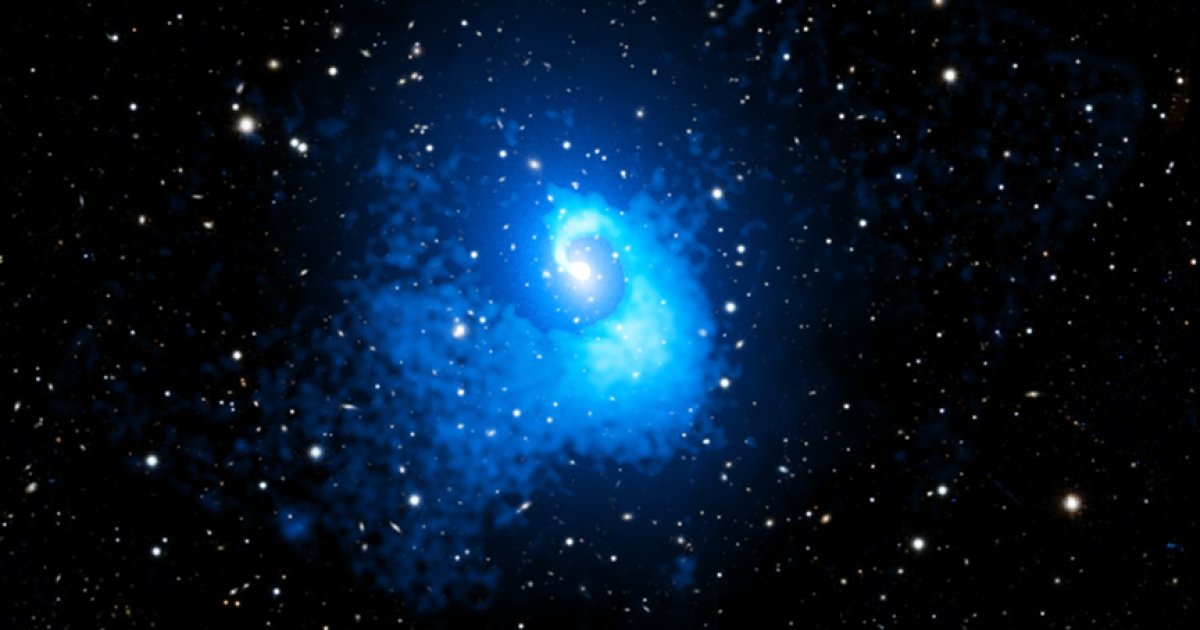
The Chandra X-ray Observatory has delivered its deepest-ever observation of the galaxy cluster Abell 2029, unveiling a remarkable 2-million-light-year 'sloshing spiral' of hot gas. This discovery, detailed in a recent paper by Courtney Watson and colleagues from Boston University and the Center for Astrophysics | Harvard & Smithsonian, offers new insights into the complex dynamics and evolution of galaxy clusters.
The Cosmic Dance of Abell 2029
Abell 2029 is a massive galaxy cluster located approximately 1 billion light-years from Earth. It is dominated by the giant elliptical galaxy IC 1101, one of the largest known galaxies. The cluster's size and mass make it an ideal subject for studying the interactions and mergers that shape galaxy clusters over billions of years. The Chandra X-ray Observatory's latest observations have revealed a 'sloshing spiral' pattern in the hot gas permeating Abell 2029. This structure is believed to be the result of a violent merger with a smaller cluster approximately 4 billion years ago. As the smaller cluster collided with Abell 2029, it set off a chain reaction of gravitational interactions, causing the hot gas to slosh around in a spiral pattern.
Understanding the Sloshing Spiral
The sloshing spiral observed in Abell 2029 is a significant finding because it provides a snapshot of the cluster's dynamic history. The spiral pattern is a direct imprint of the past merger event, offering clues about the timing, scale, and impact of the collision. Scientists estimate that such sloshing patterns can persist for billions of years, slowly dissipating as the cluster settles into a more stable state. The detailed analysis presented in the paper highlights how the sloshing spiral in Abell 2029 is composed of hot gas at temperatures reaching tens of millions of degrees. These temperatures are detectable only in the X-ray spectrum, making Chandra's capabilities essential for such studies. The spiral's structure suggests that the merger was not a head-on collision but rather a more oblique encounter, which is consistent with the complex shape of the observed gas distribution.
Implications for Galaxy Cluster Evolution
The insights gained from studying the sloshing spiral in Abell 2029 extend beyond this single cluster. They contribute to a broader understanding of galaxy cluster evolution and the role of mergers in shaping these massive cosmic structures. Galaxy clusters are the largest gravitationally bound systems in the universe, and their formation and growth are driven by the merging of smaller clusters and groups of galaxies. The presence of sloshing gas patterns like the one in Abell 2029 indicates that mergers are not only common but also have long-lasting effects on the cluster's gas dynamics and overall structure. These interactions can influence star formation rates, the distribution of dark matter, and the thermal history of the cluster. Moreover, the study of such sloshing patterns can help refine models of galaxy cluster formation and evolution. By comparing observations with simulations, scientists can test their understanding of the physical processes at play during cluster mergers. This research also has implications for cosmology, as galaxy clusters serve as important tracers of the large-scale structure of the universe.
Conclusion
Chandra's deep observation of Abell 2029 has provided a unique window into the dynamic processes that govern galaxy cluster evolution. The discovery of the sloshing spiral of hot gas offers valuable insights into the history of this massive cluster and the role of mergers in shaping the universe's largest structures. As scientists continue to analyze these findings and compare them with theoretical models, our understanding of the cosmos will continue to expand. For more details, you can read the full paper by Courtney Watson and colleagues on arXiv or explore additional resources on the Chandra X-ray Observatory website.