Discovering the Stellar Bar in GN20
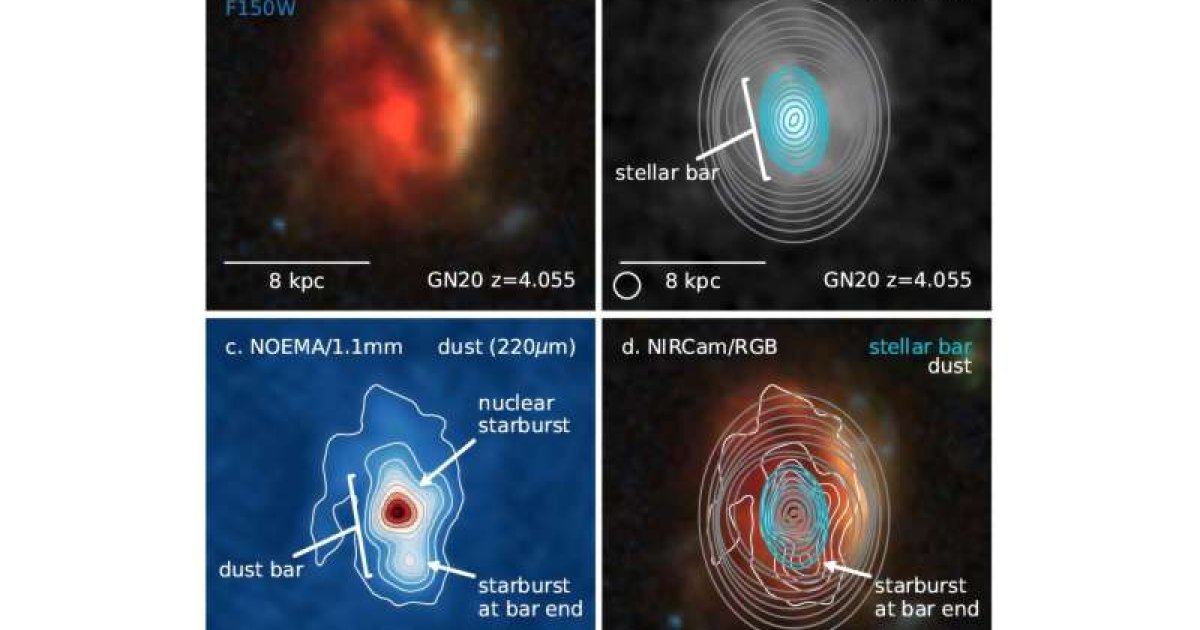
The James Webb Space Telescope (JWST) has made a groundbreaking discovery by identifying a 7-kiloparsec stellar bar within GN20, a massive, gas-rich dusty starburst galaxy located at a redshift of z=4.055. This discovery is particularly significant as GN20 is observed just 1.5 billion years after the Big Bang, offering a rare glimpse into the early universe.
The discovery was made possible through the combined capabilities of JWST's Mid-Infrared Instrument (MIRI) and Near-Infrared Camera (NIRCam), which were able to pierce through the dense dust clouds obscuring GN20. These instruments revealed the presence of a stellar bar, a structure that is typically associated with more mature galaxies. The Northern Extended Millimeter Array (NOEMA) further confirmed this finding by showing an aligned dust structure, providing additional evidence of the bar's existence.
Implications for Galaxy Formation Models
The presence of a stellar bar in GN20 challenges current models of galaxy formation and evolution. Traditionally, bars are thought to develop in galaxies much later in their lifecycles, as they require a certain level of dynamical maturity. The discovery of such a structure in the early universe suggests that galaxy formation processes may be more complex than previously thought.
Bars are significant because they can drive gas towards the center of galaxies, potentially fueling star formation and the growth of central supermassive black holes. The existence of a bar in GN20 implies that these processes might have been active much earlier in the universe's history than scientists previously estimated.
Challenging Existing Theories
Current galaxy formation models suggest that bars form in galaxies with dynamically settled disks, a condition thought to be rare in the chaotic environment of the early universe. The discovery of a bar in GN20 indicates that such conditions might have been achieved much sooner than expected, prompting astronomers to reconsider the timeline and mechanisms of galaxy evolution.
One possible explanation for the presence of the bar in GN20 is the rapid accumulation of mass and angular momentum in the galaxy's disk, potentially accelerated by interactions or mergers with other galaxies. These processes could lead to the early formation of a bar structure, although this hypothesis requires further investigation.
Future Observations and Research
The discovery of the stellar bar in GN20 opens new avenues for research into the early universe. Future observations using JWST and other telescopes will aim to identify similar structures in other distant galaxies, which could help refine our understanding of galaxy formation and evolution.
Additionally, simulations and theoretical models will need to be updated to account for the possibility of early bar formation. These models will help scientists explore the conditions under which bars can form in the early universe and their impact on galaxy evolution.
As JWST continues to explore the cosmos, its findings will undoubtedly lead to more revelations about the universe's formative years, challenging existing paradigms and expanding our understanding of cosmic history.
For more detailed information, you can access the original research paper on arXiv.