Unveiling the Secrets of NGC 4696 with JWST
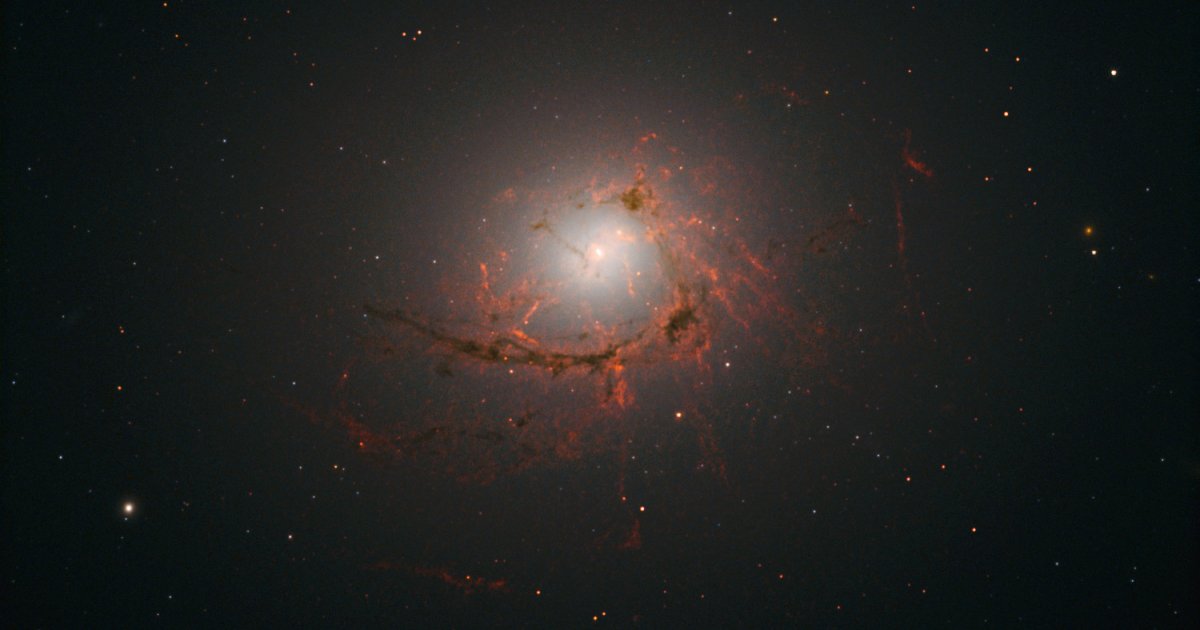
The James Webb Space Telescope (JWST) has once again demonstrated its prowess in unraveling the complexities of the universe. Utilizing its Near Infrared Spectrograph (NIRSpec) Integral Field Unit (IFU), JWST has provided unprecedented insights into the central galaxy of the Centaurus Cluster, NGC 4696, located approximately 145 million light-years away.
Tracing the Filamentary Network
In a study published on July 16, 2026, in Astrophysical Journal Letters, researchers have detailed the discovery of a kiloparsec-scale filamentary network of cool ionized gas. This network is funneling into an 800-light-year-wide rotating disk at the heart of NGC 4696. The disk, rotating at a staggering speed of 600 kilometers per second, is directly feeding the supermassive black hole (SMBH) at the galaxy's core.
The observations highlight a self-regulated cooling-flow cycle, a process that balances the inflow of gas with the energy output from the SMBH. This cycle plays a crucial role in galaxy evolution, influencing star formation rates and the growth of the black hole itself.
Understanding the Cooling-Flow Cycle
The concept of a cooling-flow cycle is not new, but JWST's observations provide the most detailed view yet of how this process operates in NGC 4696. As the ionized gas cools, it loses pressure support and begins to flow inward, forming filaments that feed the central disk. Once in the disk, the gas continues to cool and eventually spirals into the SMBH.
This process is self-regulating because the energy released by the SMBH as it accretes matter heats the surrounding gas, preventing too much gas from cooling and collapsing into the black hole too quickly. This feedback mechanism ensures that the SMBH does not grow unchecked, which could otherwise disrupt the host galaxy.
Implications for Galaxy Evolution
The findings from JWST's NIRSpec observations of NGC 4696 have significant implications for our understanding of galaxy evolution. By observing the dynamics of the cooling-flow cycle, astronomers can better comprehend how SMBHs influence their host galaxies over cosmic timescales.
NGC 4696 serves as a prime example of how SMBHs can regulate the growth and evolution of galaxies. The insights gained from this study could be applied to other galaxies with similar structures, enhancing our overall understanding of the universe's complex web of interactions.
Future Prospects
The success of JWST's NIRSpec in observing NGC 4696 opens the door for similar studies of other galaxies. By expanding our sample size, scientists can test the universality of the cooling-flow cycle and its impact on galaxy evolution. Future observations could also refine models of SMBH growth and the role of feedback mechanisms in shaping the cosmos.
As JWST continues to explore the universe, its findings will undoubtedly reshape our understanding of the intricate processes that govern galaxy and black hole formation. The detailed view of NGC 4696's inner workings is just the beginning of what promises to be a new era of discovery in astrophysics.
For more in-depth information, you can access the full study in the Astrophysical Journal Letters.