Artemis 2 Splashdown
Splashdown time is ~8:07 PM ET on April 10, 2026. Follow Orion's fiery return through Earth's atmosphere at 25,000 mph — the most dangerous 13 minutes of the mission.
Splashdown Complete
Track the Artemis 2 splashdown in real time — from the Orion capsule return through Earth's atmosphere to touchdown in the Pacific Ocean. This Artemis II re-entry tracker covers the complete descent sequence, heat shield performance, parachute deployment, and Navy recovery operations. Follow every moment of the Artemis 2 landing and Artemis 2 recovery as four astronauts return from beyond the Moon.
Return at a Glance
Watch the Return
Follow the Orion capsule's journey home with NASA's official coverage.
Artemis II Re-entry & Splashdown Explained
NASA breaks down the critical phases of Orion's return — from service module separation through skip entry, parachute deployment, and splashdown in the Pacific.
Live: Artemis II Splashdown Coverage
Watch NASA's live broadcast of the Artemis II splashdown and crew recovery operations.
Re-entry Timeline
13 minutes of things that have to go right — from atmospheric entry to splashdown.
Service Module Separation
The European Service Module is jettisoned approximately 42 minutes before splashdown. It burns up in the atmosphere. From this point, the crew module is on its own — no propulsion, no power generation beyond batteries.
Entry Interface
Orion hits the top of Earth's atmosphere at approximately 75 miles altitude, traveling at 25,000 mph — about 32 times the speed of sound. The heat shield begins absorbing extreme thermal energy.
Communications Blackout
A superheated plasma envelope forms around the capsule, blocking all radio communication with Mission Control. The crew is completely on their own for approximately 6 minutes.
Skip Entry Maneuver
Orion dips into the upper atmosphere, uses aerodynamic lift to skip back up into space, then re-enters for final descent. This technique splits the heating into two lower-intensity events and extends landing range to 5,524 miles.
Forward Bay Cover Jettison
Three pilot parachutes deploy at approximately 24,000 feet, pulling the forward bay cover away from the capsule and exposing the drogue parachute compartment.
Drogue Parachute Deployment
Two 23-foot drogue parachutes fire from mortar canisters at approximately 25,000 feet. They stabilize and slow the capsule from 324 mph, fighting tumbling and oscillation.
Main Parachute Deployment
Three 116-foot main parachutes — each covering over 10,500 square feet — deploy at approximately 9,000 feet. Together they slow the capsule to a gentle 17 mph for splashdown.
Splashdown
Orion touches down in the Pacific Ocean approximately 50–60 miles off the coast of San Diego, California, at roughly 17 mph. The crew has returned from beyond the Moon.
Skip Entry Explained
A technique conceived during Apollo but impossible to execute until now.
Unlike Apollo's direct plunge into the atmosphere, Orion uses a "skip entry" — dipping into the upper atmosphere, using aerodynamic lift to bounce back into space, then re-entering for final descent. It's like skipping a rock across water.
3× Greater Landing Range
Apollo direct entry range: ~1,725 miles. Skip entry range: ~5,524 miles. This allows precise targeting of the splashdown zone near San Diego instead of remote ocean locations.
Lower G-Forces
Instead of one high-acceleration event, skip entry creates two events of approximately 4 g's each — a significantly smoother, safer ride for the crew.
Split Heat Load
Heating is distributed across two atmospheric passes with lower peak heat rates, reducing stress on the heat shield and improving margins.
Weather Flexibility
The extended range gives Mission Control more splashdown options to avoid storms, high seas, or other adverse conditions in the recovery zone.
Apollo engineers conceived skip entry in the 1960s, but the era's navigation technology, computing power, and accuracy weren't sufficient to execute it. Modern Orion guidance systems make it possible — with less than one degree of margin on flight path angle.
Heat Shield Technology
The largest ablative heat shield ever built for a crewed spacecraft.
Orion's heat shield uses AVCOAT — silica fibers with epoxy novolac resin in a fiberglass-phenolic structure. As the shield heats during re-entry, the material chars and erodes in a controlled fashion, carrying extreme heat away from the spacecraft. At approximately 5,000°F, the shield surface reaches half the temperature of the Sun's visible surface.
Artemis I Heat Shield Fix
After Artemis I (2022), engineers discovered over 100 sites of unexpected material loss on the heat shield. Root cause: trapped gas in the reformulated AVCOAT expanded during the skip-back phase when external pressure dropped. For Artemis II, a modified skip-entry trajectory allows the material to "breathe" throughout re-entry, preventing the issue.
Parachute System
11 parachutes deploy in precise sequence to slow Orion from 324 mph to 17 mph.
Forward Bay Cover
Three small pilot parachutes fire first, pulling the forward bay cover away from the capsule 1.4 seconds later to expose the drogue compartment.
Drogue Parachutes
Two 23-foot Kevlar/Nylon drogue parachutes mortar-deploy to stabilize and slow the capsule. Each weighs 80 lbs and covers approximately 400 sq ft.
Pilot Chutes for Mains
Three mortar-deployed pilot chutes each pull out one main parachute from the packed compartment.
Main Parachutes
116-foot diameter ringsail canopies made of Kevlar/Nylon. Each weighs 310 lbs and covers over 10,500 sq ft. Designed to safely land the crew even with one main chute failed.
Recovery Operations
A precision operation to bring four astronauts safely from the Pacific Ocean to solid ground.
USS John P. Murtha (LPD 26)
Amphibious transport dock ship based at Naval Base San Diego — the primary recovery vessel for Artemis II.
Splashdown & Wait
30-45 minAfter touchdown in the Pacific, recovery teams wait 30–45 minutes for hazardous debris and fumes to dissipate before approaching.
Stabilization Collar
Navy divers from Explosive Ordnance Disposal Group 1 install an inflatable stabilization collar around the Orion capsule to prevent rolling.
Front Porch Deployment
An inflatable raft — called the "front porch" — is positioned beneath Orion's side hatch as an extraction platform for the crew.
Hatch Opening & Medical Check
Divers open the hatch, make first contact with the astronauts, and conduct initial medical assessments inside the capsule.
Crew Extraction
All four crew members exit onto the front porch raft, which is then moved approximately 100 yards from the capsule.
Helicopter Transport
Two Navy MH-60S Seahawk helicopters ferry astronauts to USS Murtha, two at a time. Two additional Seahawks provide aerial overwatch and imaging.
Medical Evaluation
~2 hrs totalDoctors and flight surgeons aboard USS Murtha conduct post-mission medical evaluations. Target: all four crew in medical bay within ~2 hours of splashdown.
Journey Home
Crew helicopter from USS Murtha to Naval Air Station North Island, then aircraft to NASA Johnson Space Center in Houston for debriefing and continued evaluation.
Artemis II Mission Gallery
Latest images from the Artemis II mission



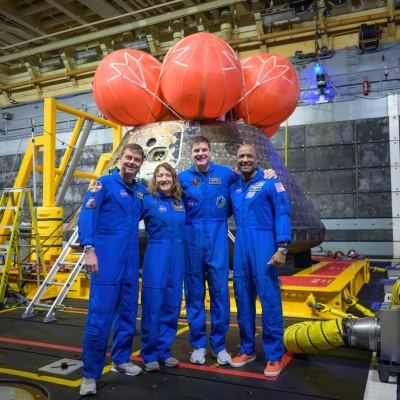
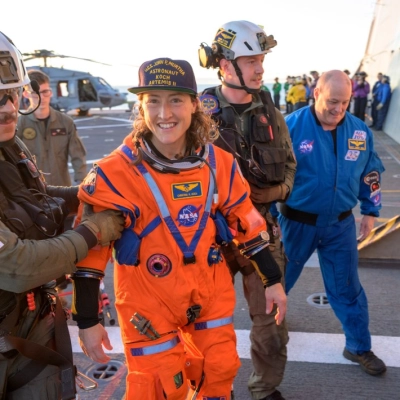
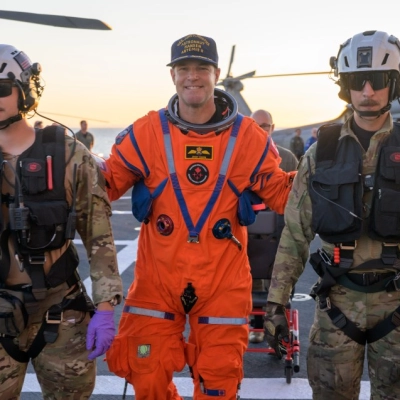
![3]NASA’s Orion spacecraft is seen as the agency’s Landing and Recovery team, along with U.S. Navy personnel work to recover...](https://jameswebbtracker.com/storage/thumbnails/e8542fd68fdb150872e4abd2ef852b90_thumb.webp)

Artemis vs. Apollo Return
How returning from the Moon has evolved in 53 years.
| Feature | Apollo | Artemis II |
|---|---|---|
| Re-entry Technique | Direct atmospheric entry | Skip entry (exits atmosphere, re-enters) |
| Heat Shield Diameter | ~12.8 ft | 16.5 ft (largest ever for crew) |
| Heat Shield Construction | 36,000 hand-filled honeycomb cells | 186 pre-machined AVCOAT blocks |
| Landing Range from Entry | ~1,725 miles | ~5,524 miles (3× greater) |
| G-Forces on Crew | Single high-acceleration event | Two events of ~4 g's each |
| Crew Capacity | 3 astronauts | 4 astronauts |
| Recovery Ship | Aircraft carriers (e.g., USS Hornet) | Amphibious dock ship (USS Murtha) |
| Splashdown Targeting | Remote Pacific locations | Precise: ~50 mi off San Diego |
| Post-Recovery Quarantine | Weeks (contamination concern) | None required (no surface contact) |
| Navigation Computing | Minimal onboard | Advanced digital guidance |
Re-entry Technique
Direct atmospheric entry
Skip entry (exits atmosphere, re-enters)
Heat Shield Diameter
~12.8 ft
16.5 ft (largest ever for crew)
Heat Shield Construction
36,000 hand-filled honeycomb cells
186 pre-machined AVCOAT blocks
Landing Range from Entry
~1,725 miles
~5,524 miles (3× greater)
G-Forces on Crew
Single high-acceleration event
Two events of ~4 g's each
Crew Capacity
3 astronauts
4 astronauts
Recovery Ship
Aircraft carriers (e.g., USS Hornet)
Amphibious dock ship (USS Murtha)
Splashdown Targeting
Remote Pacific locations
Precise: ~50 mi off San Diego
Post-Recovery Quarantine
Weeks (contamination concern)
None required (no surface contact)
Navigation Computing
Minimal onboard
Advanced digital guidance
Splashdown FAQ
Everything you need to know about the Artemis 2 splashdown time, re-entry, and recovery.
results found
The Artemis 2 splashdown time is approximately 8:07 PM ET (Eastern Time) on April 10, 2026. That is 5:07 PM PT for viewers on the West Coast. Splashdown occurs in the Pacific Ocean about 50–60 miles off the coast of San Diego, California.
The Artemis 2 splashdown time is approximately 8:07 PM ET on April 10, 2026. In other time zones: 7:07 PM CT (Central), 6:07 PM MT (Mountain), 5:07 PM PT (Pacific), and 12:07 AM UTC on April 11. NASA coverage typically begins several hours before the scheduled splashdown time.
The Orion capsule splashes down in the Pacific Ocean approximately 50–60 miles off the coast of San Diego, California. The recovery zone was chosen for its proximity to Naval Base San Diego and Navy recovery assets.
Orion enters Earth's atmosphere at approximately 25,000 mph (Mach 32) — about 32 times the speed of sound. This makes it the fastest crewed vehicle re-entry since the Apollo era over 50 years ago.
Skip entry is a technique where the capsule dips into the upper atmosphere, uses aerodynamic lift to bounce back into space, then re-enters for final descent — like skipping a rock on water. It reduces peak g-forces on the crew, splits the heat load into two passes, and extends the landing range from 1,725 miles (Apollo) to 5,524 miles, enabling precise splashdown targeting.
The AVCOAT heat shield reaches approximately 5,000°F (2,760°C) during re-entry — roughly half the temperature of the Sun's visible surface. The 16.5-foot shield is the largest ablative heat shield ever built for a crewed spacecraft.
Yes. After Artemis I revealed over 100 sites of unexpected material loss caused by trapped gas in the AVCOAT, engineers modified the skip-entry trajectory for Artemis II. The new trajectory allows the material to breathe throughout re-entry, preventing gas buildup and crack formation.
Orion deploys 11 parachutes in sequence: 3 pilot chutes to remove the forward bay cover, 2 drogue parachutes (23 ft each) to stabilize the capsule, 3 more pilot chutes to extract the mains, and 3 main parachutes (116 ft each) that slow the capsule to approximately 17 mph for splashdown.
When Orion enters the atmosphere at 25,000 mph, the extreme friction creates a superheated plasma envelope around the capsule. This plasma blocks all radio signals, cutting communication between the crew and Mission Control for approximately 6 minutes. The crew is completely on their own during this period.
The USS John P. Murtha (LPD 26), an amphibious transport dock ship based at Naval Base San Diego, is the primary recovery vessel. Navy divers from Explosive Ordnance Disposal Group 1 and MH-60S Seahawk helicopters from Helicopter Sea Combat Squadron 23 assist with crew extraction.
The target is to have all four crew members in the medical bay aboard USS Murtha within approximately 2 hours of splashdown. Recovery teams first wait 30–45 minutes for hazardous fumes to clear, then divers install a stabilization collar and extraction raft before opening the hatch.
The "front porch" is an inflatable raft positioned beneath Orion's side hatch. It serves as an extraction platform where astronauts step out of the capsule. Once all four crew members are on the raft, it's moved about 100 yards from the capsule before helicopter pickup.
No. Unlike the Apollo missions where crews were quarantined for weeks due to concerns about lunar surface contamination, Artemis II astronauts did not land on the Moon's surface, so no quarantine is required. They proceed directly to medical evaluation and debriefing.
Apollo used direct atmospheric entry with a single high-g event, limited landing range (~1,725 mi), and 36,000 hand-filled heat shield cells. Artemis uses skip entry with two lower-g events (~4 g's each), 3× greater landing range (~5,524 mi), 186 pre-machined AVCOAT blocks, and modern navigation that Apollo lacked.
Yes. The Orion parachute system is designed with redundancy — the capsule can safely land with only two of the three main parachutes functioning. The system was extensively tested with deliberate single-chute failures before certification.
Recovery requires no precipitation or thunderstorms within 30 nautical miles of the splashdown zone, wave heights below 6 feet, and winds under 25 knots. The skip entry technique gives Mission Control flexibility to adjust the splashdown time and landing point if weather conditions change.
No questions match your search
Try different keywords or
16 questions answered about the Artemis II splashdown and recovery
Track the Full Artemis II Mission
See the complete Artemis II tracker with live countdown, crew profiles, mission timeline, telemetry dashboard, and more.