Introduction to the FEAST Programme
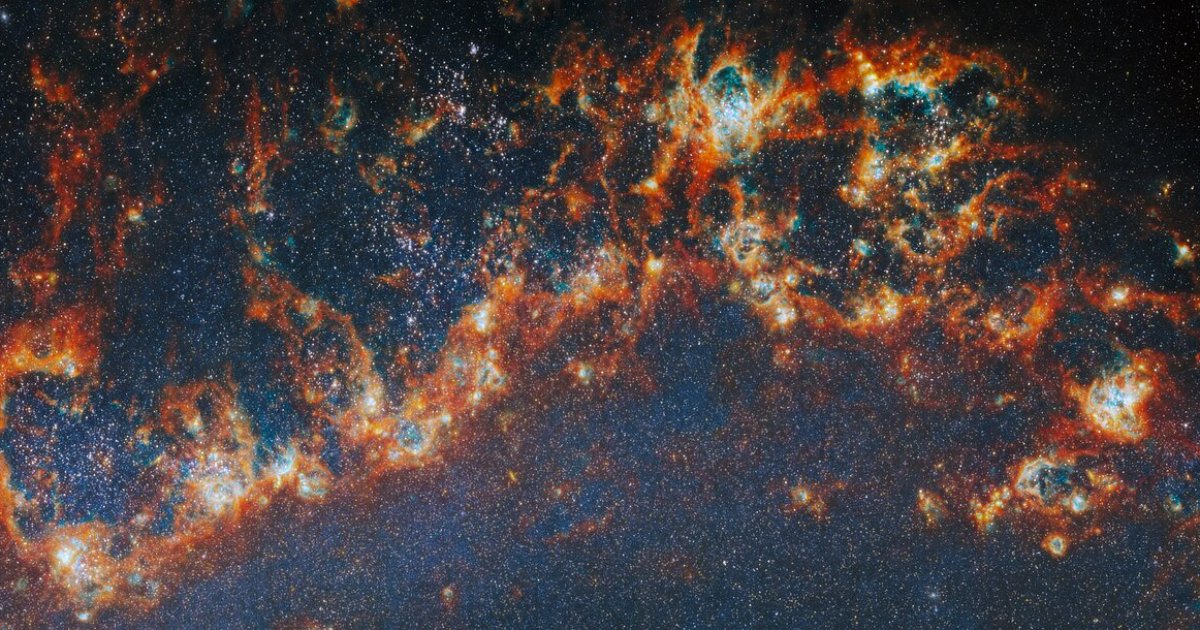
The Feedback in Emerging Star Clusters (FEAST) programme, a collaborative effort utilizing the James Webb Space Telescope (JWST) and the Hubble Space Telescope, has provided groundbreaking insights into the emergence of young star clusters in nearby galaxies. By focusing on galaxies such as M51, M83, NGC 628, and NGC 4449, the programme has revealed crucial data on how these clusters disperse their birth gas, a process essential for understanding stellar feedback and planet formation.
Key Findings on Cluster Emergence
The FEAST programme's observations indicate that massive star clusters are capable of dispersing their birth gas within approximately 5 million years. In contrast, lower-mass clusters require about 7 to 8 million years to achieve the same level of gas dispersal. This timing difference is significant because it highlights the varying dynamics and feedback mechanisms at play in star clusters of different masses.
Implications for Stellar Feedback
Stellar feedback refers to the processes by which stars influence their surrounding environment, primarily through radiation, stellar winds, and supernovae. The FEAST findings suggest that massive clusters, by dispersing their gas more rapidly, might exert a stronger and more immediate influence on their surroundings. This rapid feedback can trigger further star formation in nearby regions or, conversely, inhibit it by dispersing the necessary gas and dust.
Lower-mass clusters, with their extended gas dispersal timelines, might allow for a more gradual feedback process. This could lead to different star formation patterns and potentially affect the chemical enrichment of their host galaxies over time.
Impact on Planet Formation
The timing of gas dispersal in star clusters also has implications for planet formation. Planets form from the residual gas and dust left over after star formation. Therefore, the rapid dispersal of gas in massive clusters might limit the material available for planet formation, potentially influencing the types and sizes of planets that can form.
In lower-mass clusters, the extended presence of gas could provide a more conducive environment for planet formation, possibly leading to a higher likelihood of forming diverse planetary systems. This extended timeline might also allow for the formation of more complex molecules, which are the building blocks of life.
Technological Contributions of Webb and Hubble
The FEAST programme's success is largely due to the complementary capabilities of the JWST and Hubble. Webb's Near Infrared Camera (NIRCam) provides unprecedented sensitivity and resolution in the infrared spectrum, allowing scientists to peer through dust clouds that obscure young star clusters. Meanwhile, Hubble's optical and ultraviolet instruments offer detailed views of the clusters' environments and the effects of stellar feedback.
This synergy between the two telescopes has enabled the FEAST programme to conduct a comprehensive study of star cluster emergence, offering new insights into the lifecycle of stars and their planetary systems.
Conclusion
The findings from the FEAST programme underscore the complexity of star formation and the critical role of stellar feedback in shaping galaxies. By understanding the timelines of gas dispersal in star clusters, scientists can better predict the conditions under which stars and planets form, ultimately enhancing our knowledge of the universe's evolution.
As the FEAST programme continues to analyze data from Webb and Hubble, further discoveries are anticipated, potentially reshaping our understanding of cosmic phenomena and the intricate dance of stars and planets in the universe.