Sagittarius A* - The supermassive black hole at the center of our Milky Way Galaxy.
Astronomers have found that the supermassive black hole at the center of the Milky Way, known as Sagittarius A* (Sgr A*), is blowing a hot cosmic wind — something scientists have been hunting for over 50 years.
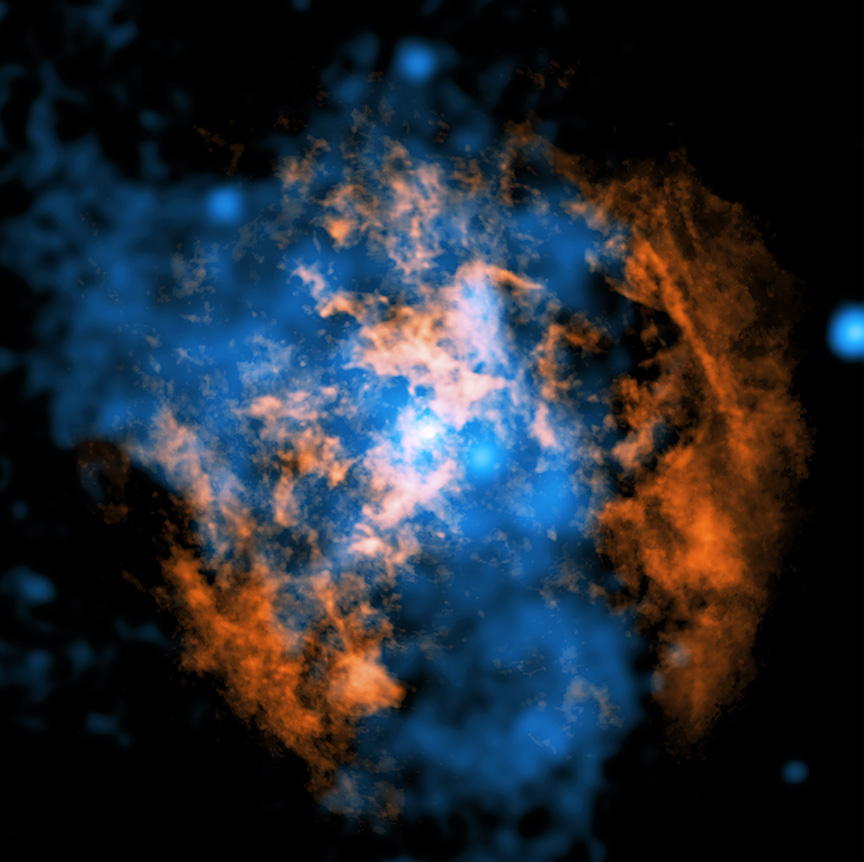
This composite image shows the evidence for the wind blowing away from Sgr A*. The white dot in the center of the image shows Sgr A*. In orange is data from the Atacama Large Millimeter/Submillimeter Array (ALMA) radio telescopes in Chile, mapping the location of cold gas composed of carbon monoxide in the image. In blue is X-ray data from NASA’s Chandra X-ray Observatory. A large cone-shaped cavity, visible as an absence of cold gas in the ALMA data, is filled by hot X-ray-emitting gas in the Chandra data. Researchers think a hot, energetic wind blowing from Sgr A* created this structure by sweeping the cold gas away or heating it up.
Theory says that when a black hole feeds on gas, it should also blow some material back out as winds or jets. Until now, the wind coming from our own Galaxy’s black hole had never been seen clearly. Using several years of highly detailed ALMA observations, astronomers mapped cold gas within just a few light‑years of Sgr A*. After carefully removing the black hole’s bright radio glow, they uncovered a giant, cone‑shaped hole in the cold gas, pointing straight at the black hole — the unmistakable imprint of a large, hot, active wind launched from Sgr A*.
A paper by Mark Gorski and Lena Murchikova (Northwestern University) describing these results has been accepted in The Astrophysical Journal Letters. NASA's Marshall Space Flight Center in Huntsville, Alabama, manages the Chandra program. The Smithsonian Astrophysical Observatory's Chandra X-ray Center controls science operations from Cambridge, Massachusetts, and flight operations from Burlington, Massachusetts.
Visual Description:This image centers on a bright, pinpoint white glow marking Sagittarius A* (Sgr A*), the supermassive black hole at the heart of the Milky Way, surrounded by a turbulent, cloud-like environment. Radiating outward from the center is a luminous swirl of blue X-ray emission from NASA's Chandra X-ray Observatory, forming a soft, irregular halo that is brightest near the core and fades into darker shades toward the edges. Interwoven with this blue glow are thick, patchy structures in orange, tracing colder gas mapped by radio observations from ALMA. These orange regions form a partial ring and clumpy arcs around the center, but notably break open to reveal a wide, cone-shaped cavity where little to no orange emission appears. This hollowed-out region is instead filled with the blue X-ray glow, emphasizing the contrast between hot and cold material. The scene feels dynamic and layered, with the interplay of blue and orange just a few light-years from the galaxy’s core.
Image Details
| Credit | X-ray: NASA/CXC/Northwestern Univ./M. Gorski; Radio:ESO/NAOJ/NRAO/ALMA; Image processing: NASA/CXC/SAO: K. Arcand, P. Edmonds |
| Release Date | June 4, 2026 |
| Scale | Image is about 57.1 arcsec (7.2 light-years) across. |
| Category | Black Holes, Milky Way Galaxy |
| Coordinates (J2000) | RA 17h 45m 40s | Dec -29° 00´ 28.00" |
| Constellation | Sagittarius |
| Observation Dates | 43 pointings from September 21, 1999 to May 18, 2009 |
| Observation Time | 278 hours (11 days, 14 hours) |
| Obs. ID | 242, 1561, 2943, 2951-2954, 3392, 3393, 3549, 3663, 3665, 4683, 4684, 5360, 5950, 5951-5954, 6113, 6363, 6639, 6640-6646, 7554-7559, 9169-9174, 10556 |
| Instrument | ACIS |
| Also Known As | Galactic Center |
| References | Gorski, M. and Murchikova, E., 2026, ApJL, Accepted. |
| Color Code | X-ray: blue; Radio: orange |
| Distance Estimate | About 26,000 light-years from Earth |