Introduction
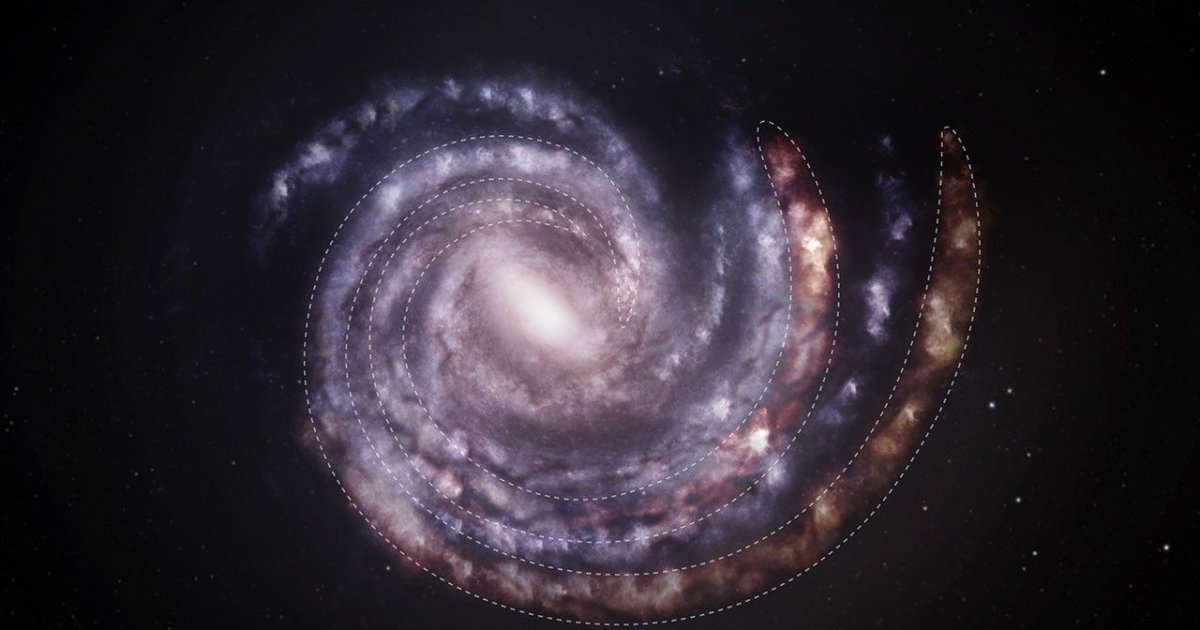
Astronomers have long been intrigued by the structure of our galaxy, the Milky Way, particularly its spiral arms. Recent findings led by Beatrice Vaia have provided new insights into the distances of these arms from the Galactic Center. By utilizing gamma-ray burst (GRB) light echoes, researchers have discovered that the Outer and Outer Scutum-Centaurus arms are approximately 10% farther from the Galactic Center than previously thought.
Gamma-Ray Burst Light Echoes
Gamma-ray bursts are among the most energetic events in the universe, releasing immense amounts of energy in short periods. When these bursts occur, their light can travel vast distances, sometimes interacting with cosmic dust clouds. This interaction creates light echoes, which can be used to measure distances in space through geometric triangulation.
Methodology
The team led by Vaia employed data from NASA's Chandra X-ray Observatory and ESA's XMM-Newton telescope to observe these light echoes. By analyzing how the light from GRBs reflected off dust clouds within the Milky Way, they could determine the distances to the spiral arms with unprecedented precision. This method provides a geometric approach to measuring galactic structures, offering a fresh perspective compared to traditional methods like star counts and radio observations.
Revising the Milky Way's Spiral Arm Distances
The study's findings suggest that the Outer and Outer Scutum-Centaurus arms are about 10% farther from the Galactic Center than previously estimated. This revision is significant because it alters our understanding of the Milky Way's structure and dynamics. The implications of these findings extend to models of galactic formation and evolution, as well as our understanding of the Milky Way's mass distribution.
Implications for Galactic Models
With the revised distances, scientists can refine models of the Milky Way's spiral structure, leading to better predictions of star formation rates and the distribution of interstellar material. These models are crucial for understanding not only our galaxy but also the behavior and evolution of spiral galaxies in general.
Future Research Directions
This breakthrough opens new avenues for research. Future studies could focus on applying the light echo technique to other regions of the Milky Way or even other galaxies. Additionally, this method could be used to explore the distribution and properties of dust clouds, which play a critical role in star formation and galactic dynamics.
For more detailed information on this study, you can visit the Chandra press release or the Chandra photo archive.