Unveiling the Mysteries of M87's Jet
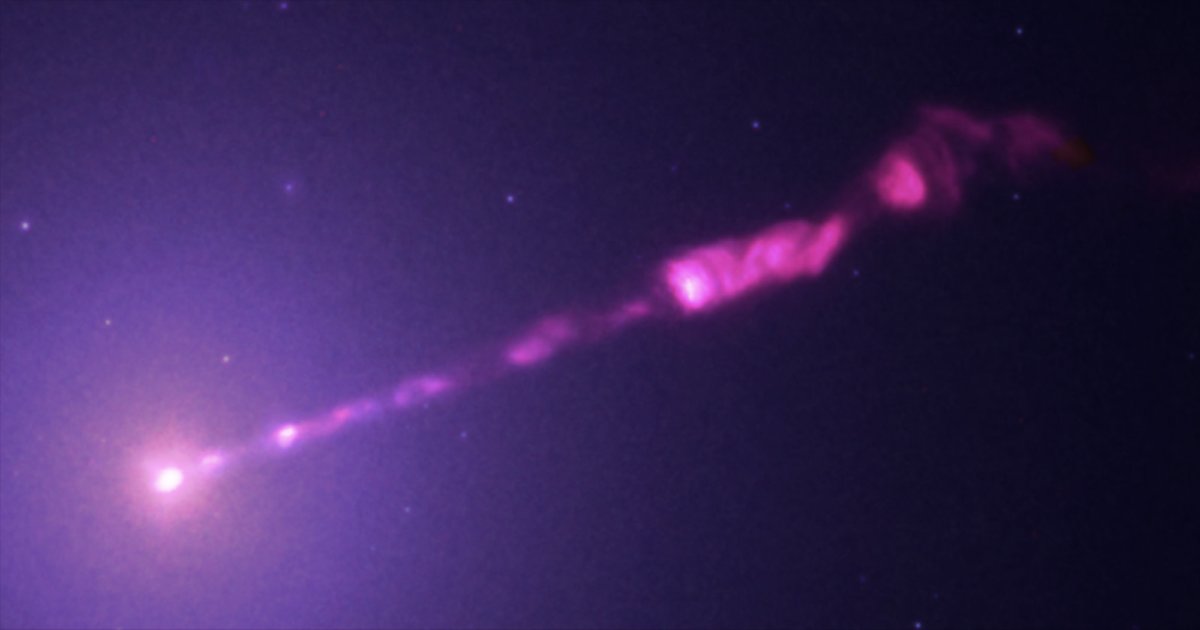
The supermassive black hole at the center of the galaxy M87 has long intrigued astronomers, and recent findings from NASA's Chandra X-ray Observatory have added a new layer of complexity to this cosmic enigma. On June 15, 2026, NASA released groundbreaking results led by Camille Poitras from Laval University, presented at the 248th meeting of the American Astronomical Society (AAS). These findings focus on the evolving X-ray jet emanating from M87's supermassive black hole, tracked meticulously over more than a decade.
Deconvolution of Chandra HRC Data
The research team utilized deconvolution techniques on data collected by Chandra's High Resolution Camera (HRC) from 2012 to 2025. This process allowed them to resolve fine structures within the jet that were previously obscured. By analyzing these structures, the team was able to observe phenomena that challenge conventional understanding, such as apparent superluminal motion—where parts of the jet seem to move at speeds up to five times the speed of light.
Understanding Superluminal Motion
Superluminal motion is a fascinating illusion that occurs when objects move close to the speed of light at certain angles relative to the observer. In the case of M87, this apparent motion is not a violation of the cosmic speed limit but rather a result of relativistic effects. The jet's particles are moving at velocities approaching the speed of light, creating the illusion of faster-than-light travel when viewed from Earth.
Synchrotron Cooling and Jet Evolution
Another significant aspect of the study was the observation of synchrotron cooling within the jet. As charged particles spiral around magnetic fields, they emit synchrotron radiation, losing energy in the process. This cooling effect provides insights into the jet's composition and the dynamics of its magnetic fields. Over the decade-long observation period, scientists estimate that these processes have led to noticeable changes in the jet's structure and brightness.
Implications for Black Hole Physics
The findings from Chandra's observations of M87's jet have profound implications for our understanding of black hole physics and jet dynamics. By resolving the jet's fine structures, astronomers can better understand the mechanisms driving jet formation and evolution. This knowledge is crucial for constructing accurate models of jet behavior, which are essential for interpreting observations of other active galactic nuclei.
Future Observations and Research
The research led by Camille Poitras sets the stage for future studies of M87 and other similar systems. Continued observations with Chandra and other telescopes will help refine our understanding of jet dynamics and the environments surrounding supermassive black holes. As technology advances, scientists anticipate even more detailed insights into these cosmic phenomena.
For more information on this study, you can visit the Chandra X-ray Observatory's official page and the NASA Chandra Mission page.