Introduction to ESO 490-017
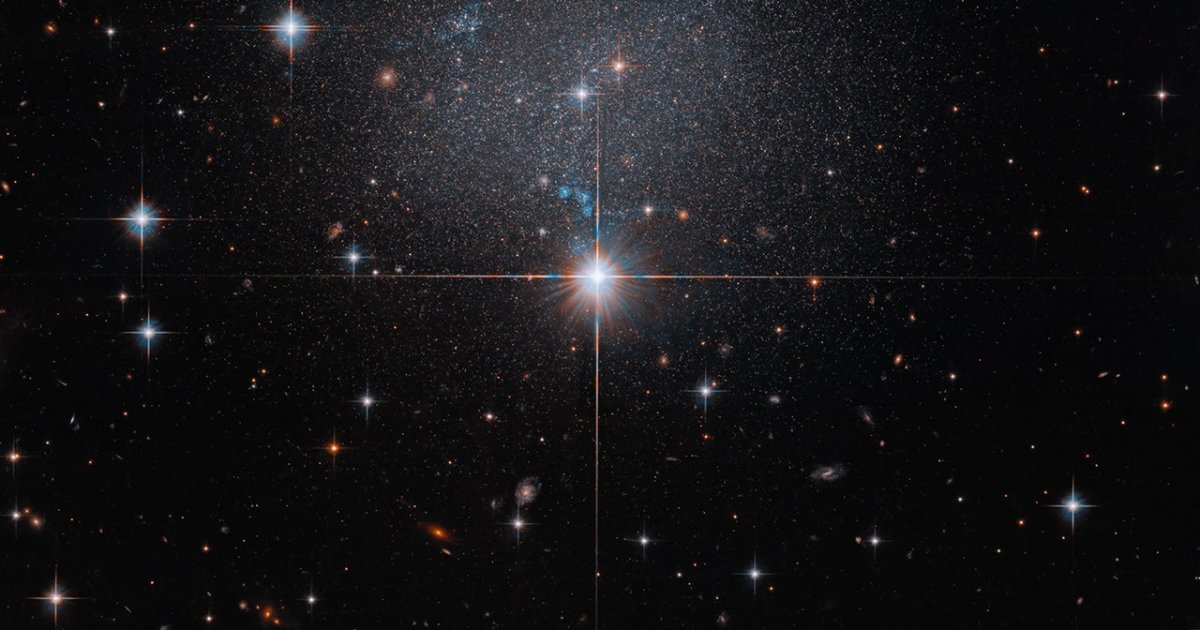
The Hubble Space Telescope has captured a stunning new image of the dwarf irregular galaxy ESO 490-017, located approximately 23 million light-years away in the constellation Canis Major. This galaxy, spanning about 12,000 light-years, is a focal point in a larger study aimed at understanding cosmic flow—the gravity-driven motion of large-scale structures in the universe.
Understanding Cosmic Flow
Cosmic flow refers to the movement of galaxies and galaxy clusters through space, driven by gravitational forces. These flows can reveal important information about the distribution of mass in the universe, including dark matter, which is not directly observable. By studying how galaxies like ESO 490-017 move, astronomers can infer the underlying gravitational forces at play.
The Role of ESO 490-017
ESO 490-017 serves as a key target in this cosmic flow research due to its relative proximity and the simplicity of its structure as a dwarf irregular galaxy. These characteristics make it an ideal candidate for precise distance measurements, which are crucial for mapping cosmic flow accurately.
Red Giant Stars as Standard Candles
One of the innovative methods employed in this research involves using low-mass red giant stars as standard candles. These stars, found in abundance in galaxies like ESO 490-017, have predictable luminosities at certain stages of their evolution. By measuring their apparent brightness, astronomers can determine their distances with high precision.
This technique is part of a broader effort to refine the cosmic distance ladder, a series of methods used to measure distances to astronomical objects. Accurate distance measurements are essential for understanding the scale and structure of the universe.
Implications of the Study
The insights gained from observing ESO 490-017 and similar galaxies contribute to a more comprehensive understanding of cosmic flow. This, in turn, enhances our knowledge of the universe's large-scale structure and the forces shaping it. The data gathered by Hubble will help astronomers refine models of cosmic evolution and improve predictions about the future behavior of the universe.
For more detailed information on the Hubble program and its findings, you can visit the Phys.org article or explore resources provided by the NASA Hubble site.