Introduction to Messier 88's Cosmic Journey
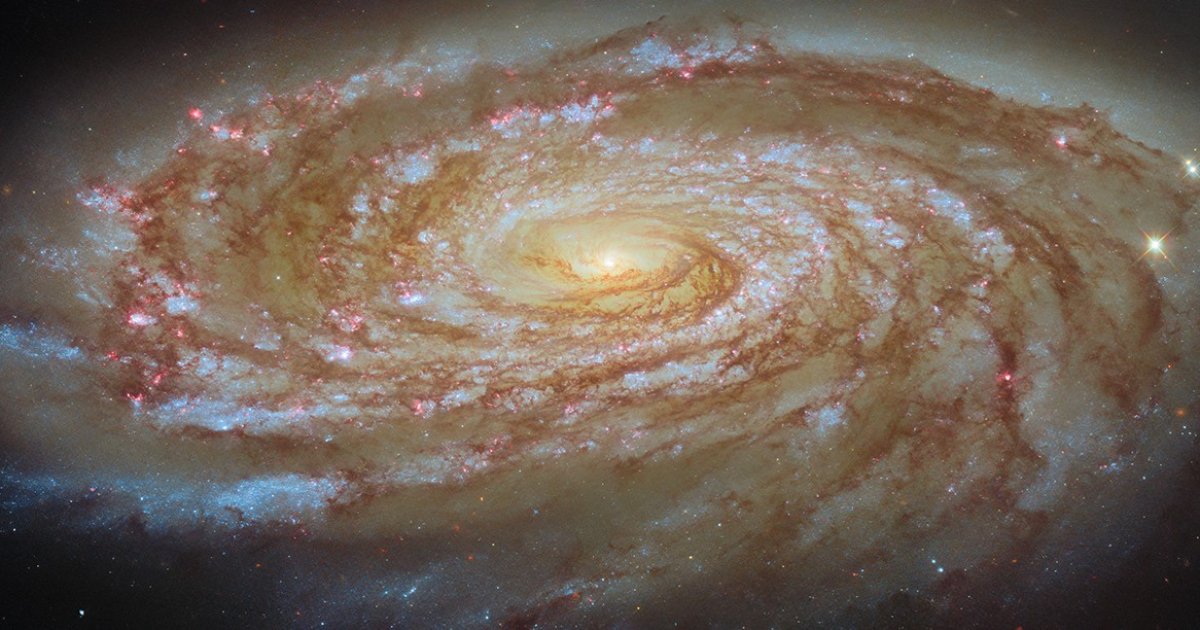
In June 2026, the Hubble Space Telescope captured a breathtaking image of the spiral galaxy Messier 88 (M88) as it hurtles through the Virgo Cluster towards the massive elliptical galaxy Messier 87 (M87). This celestial event offers a unique opportunity to study the effects of ram pressure stripping on a galaxy's star-forming capabilities and overall structure. The image, released by NASA and the European Space Agency (ESA), highlights the intricate dynamics of M88's journey, providing valuable insights into galactic evolution.
The Compressed Leading-Edge Gas Disk
As M88 plunges through the dense intracluster medium of the Virgo Cluster, its leading-edge gas disk becomes compressed. This compression is a direct result of ram pressure stripping, a process where the pressure exerted by the hot, diffuse gas in the cluster strips away the galaxy's own gas. This phenomenon is particularly evident in the Hubble image, where the leading edge of M88 appears brighter and more defined, indicating an increase in star formation activity due to the compression of gas.
Depletion of Cold Gas Reservoirs
While the leading edge of M88 experiences enhanced star formation, the galaxy's overall cold gas reservoir is being depleted. The process of ram pressure stripping effectively removes the cold gas that is essential for forming new stars, leading to a decline in star formation over time. Scientists estimate that this depletion will significantly impact M88's ability to sustain its current star formation rate as it continues its journey through the cluster.
The Central Black Hole
At the heart of M88 lies a supermassive black hole with an estimated mass of around 100 million solar masses. This black hole plays a crucial role in the dynamics of the galaxy, influencing its structure and evolution. As M88 approaches M87, gravitational interactions between the two galaxies could potentially affect the activity of this central black hole, leading to increased accretion and possibly triggering active galactic nucleus (AGN) activity.
Distance and Timeline of M88's Journey
Located approximately 63 million light-years from Earth, M88 is on a fascinating trajectory through the Virgo Cluster. Scientists estimate that it will take about 200 to 300 million years for M88 to reach its closest approach to M87. This timeline provides astronomers with a rare opportunity to observe and study the long-term effects of ram pressure stripping and gravitational interactions on a spiral galaxy.
Implications for Galactic Evolution
The observations of M88's journey through the Virgo Cluster have significant implications for our understanding of galactic evolution. Ram pressure stripping is a critical process that can transform spiral galaxies into lenticular or elliptical galaxies by removing their star-forming gas. The data collected from Hubble's observations of M88 will help refine models of galaxy evolution and enhance our understanding of the life cycles of galaxies in dense environments.
Conclusion
Hubble's June 2026 image of Messier 88 provides a vivid snapshot of a galaxy undergoing dramatic changes as it navigates the complex environment of the Virgo Cluster. By studying M88's compressed leading-edge gas disk, depleted cold gas reservoirs, and central black hole, astronomers can gain valuable insights into the processes that shape galaxies over cosmic time. As M88 continues its journey, it will undoubtedly offer further opportunities for discovery and deepen our understanding of the universe.
For more information, you can read the full ScienceDaily article or explore the ESA's multimedia coverage.