Understanding Planetary Nebulae
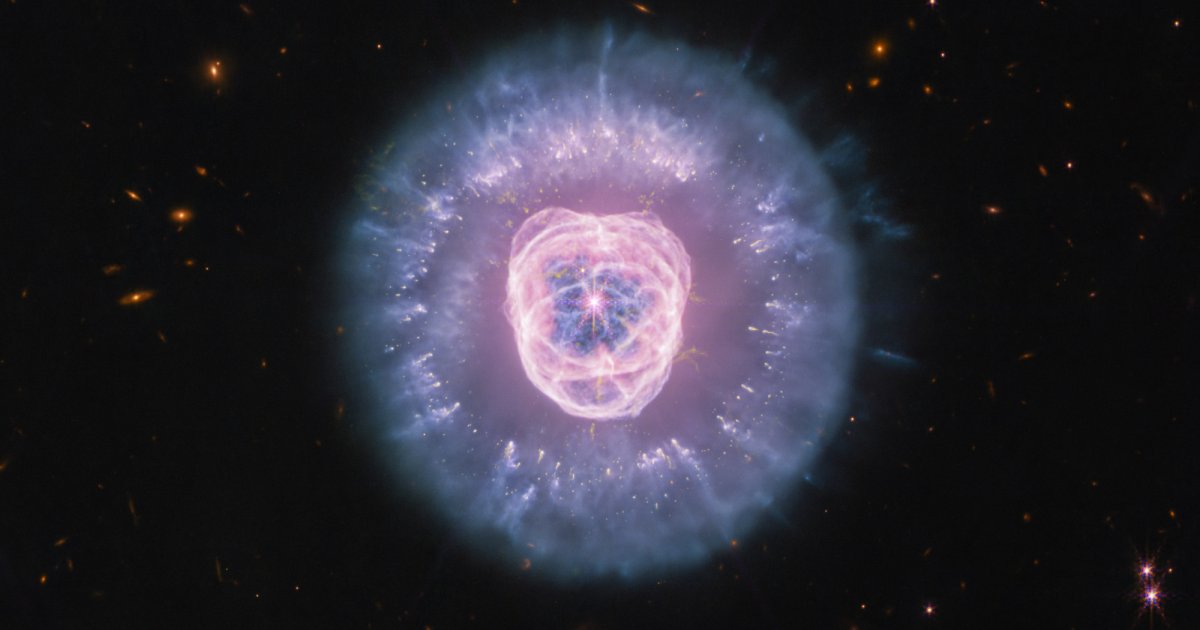
Planetary nebulae, despite their name, have nothing to do with planets. They are instead the stunning remnants of dying stars, typically those similar in size to our Sun. When these stars exhaust their nuclear fuel, they expel their outer layers into space, creating a colorful shell of ionized gas. Over time, this gas disperses into the interstellar medium, enriching it with elements that can form new stars and planets. Hubble's 2000 image of NGC 2392, also known as the Lion Nebula, offered a visible light view of this process, revealing intricate details of the nebula's structure.
Webb's Infrared Advantage
The James Webb Space Telescope (JWST) has now provided a fresh perspective on NGC 2392 using its Near-Infrared Camera (NIRCam) and Mid-Infrared Instrument (MIRI). Unlike visible light, infrared wavelengths can penetrate the dust and gas that often obscure celestial objects, offering a clearer view of the nebula's core and its surrounding features. This capability allows scientists to study the temperature, composition, and dynamics of the nebula's gas and dust in unprecedented detail.
Webb's infrared image, released on August 10, 2026, highlights the intricate structures within the Lion Nebula, which were less apparent in Hubble's visible-light observations. The infrared view reveals cooler regions and the presence of complex molecules that are crucial for understanding the nebula's evolution and the processes occurring within it. NASA's Webb mission page offers further insights into these findings.
The Mane-Shaped Comet-Like Knots
One of the most striking features of NGC 2392 is its mane-shaped comet-like knots, which are particularly prominent in Webb's new image. These structures are formed by the interaction of fast stellar winds with the slower-moving material previously ejected by the dying star. Scientists estimate that these knots provide crucial clues about the star's mass loss and the mechanisms driving it.
As the star sheds its outer layers, the material forms these knotty structures, which are then sculpted by the intense radiation and winds from the hot core. Over the next 10,000 years, scientists predict that these knots will disperse into the surrounding space, contributing to the cycle of stellar evolution by enriching the interstellar medium with heavier elements.
Implications for Stellar Evolution
The detailed study of NGC 2392's comet-like knots and other features offers valuable insights into the late stages of stellar evolution. By understanding how stars like our Sun lose mass and contribute to the galactic environment, astronomers can better predict the future of our own solar system and the lifecycle of stars in general.
The new data from Webb's infrared instruments not only enhances our understanding of NGC 2392 but also serves as a benchmark for studying other planetary nebulae. This research underscores the importance of infrared astronomy in unraveling the complexities of the universe.