Introduction to OMC-2: A Stellar Nursery
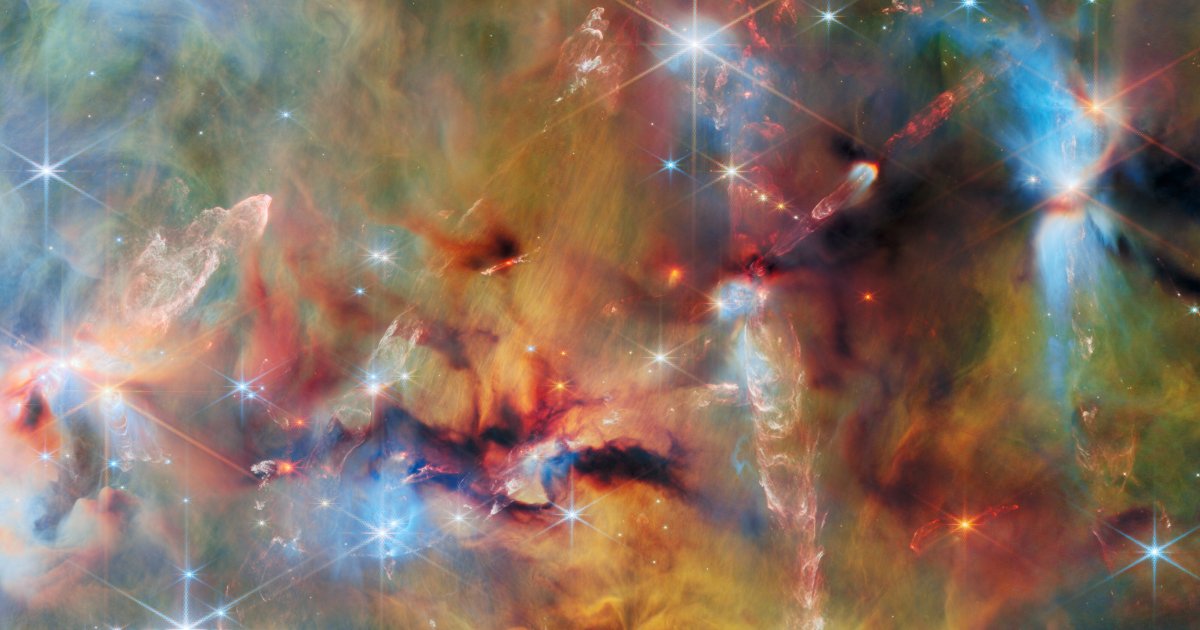
The Orion Molecular Cloud-2 (OMC-2) is a captivating filament of cold gas and dust, stretching approximately 150 light-years and located 1,280 light-years away from Earth, just beyond the Orion Nebula. This region is a significant focus for astronomers studying the star formation lifecycle, and the James Webb Space Telescope (JWST) has provided unprecedented insights with its Near Infrared Camera (NIRCam). The June 2026 ESA Picture of the Month showcases OMC-2, revealing the intricate processes involved in star formation.
Unveiling the Star Formation Lifecycle
OMC-2 is a unique laboratory for understanding the star formation lifecycle, as it presents every stage of this cosmic phenomenon within a single frame. The NIRCam on JWST has captured stellar embryos, protoplanetary disks, and pre-main sequence stars, offering a comprehensive view of how stars evolve from their nascent stages.
Stellar Embryos: The Birth of Stars
Stellar embryos are the initial phase in the star formation process. These dense cores of gas and dust are where gravity begins to take hold, pulling material inward and initiating nuclear fusion. In OMC-2, the JWST's observations allow scientists to study these early stages in great detail, providing clues about the conditions necessary for star birth.
Protoplanetary Disks: Cradles of Planetary Systems
As stellar embryos evolve, they often form protoplanetary disks. These disks are composed of gas and dust that orbit the young star, potentially leading to the formation of planets. The JWST's NIRCam has been instrumental in identifying these disks within OMC-2, offering insights into the materials and conditions that might influence planet formation. According to NASA, understanding these disks is crucial for comprehending how planetary systems, including our own, come into being.
Pre-Main Sequence Stars: Maturing Stars
Pre-main sequence stars represent a later stage in the star formation lifecycle. These stars have not yet reached the main sequence phase, where they will spend the majority of their lives. In OMC-2, the JWST has identified numerous pre-main sequence stars, providing a snapshot of stars in the process of maturing and stabilizing. These observations help astronomers understand the physical changes stars undergo before settling into a stable phase.
Why OMC-2 is a Unique Laboratory
OMC-2's significance lies in its ability to showcase the complete star formation lifecycle in one region. This makes it an invaluable site for astronomers seeking to understand the complexities of star birth and evolution. The dense concentration of material in OMC-2, combined with its relative proximity, allows for detailed study using advanced instruments like the JWST.
The filament's structure also provides a unique opportunity to study how environmental factors influence star formation. Variations in density, temperature, and magnetic fields within OMC-2 can affect how stars form and evolve. By examining these factors, scientists can gain a deeper understanding of the processes that govern star formation across the universe.
Conclusion
The James Webb Space Telescope's observations of OMC-2 have opened new avenues for understanding the star formation lifecycle. By capturing every stage of this process, from stellar embryos to pre-main sequence stars, JWST provides a comprehensive view of how stars are born and evolve. OMC-2 serves as a unique laboratory, offering insights that could reshape our understanding of star formation and the conditions that lead to the creation of planetary systems.