Introduction
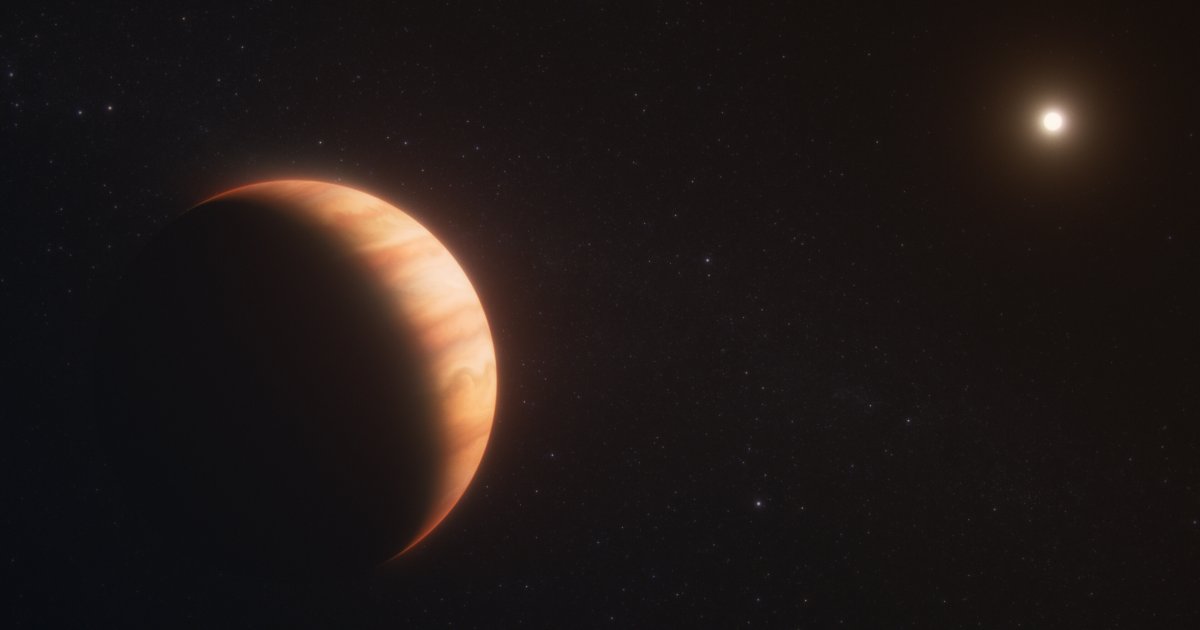
The James Webb Space Telescope (JWST) has achieved a groundbreaking discovery by detecting the first atmosphere on a planet orbiting a white dwarf star. This revelation, published in Nature in July 2026, focuses on WD 1856 b, a Jupiter-sized exoplanet orbiting the white dwarf WD 1856+534, located approximately 80 light-years away from Earth. This discovery not only sheds light on the characteristics of this unique exoplanet but also provides a glimpse into the potential future of our own Solar System.
WD 1856 b: A Unique Exoplanet
WD 1856 b is a remarkable exoplanet, with a mass estimated to be between 4 to 11 times that of Jupiter (4-11 MJup). It orbits its white dwarf host star, WD 1856+534, at a distance that allows it to maintain a temperature of approximately 126°C (259°F). The detection of an atmosphere on this planet is particularly significant because it marks the first time that such an atmosphere has been observed around a planet orbiting a dead star.
Atmospheric Composition: Methane and Hydrocarbons
Using the Near Infrared Spectrograph (NIRSpec) on JWST, scientists have identified the presence of methane and other hydrocarbons in the atmosphere of WD 1856 b. The presence of these compounds suggests a complex atmospheric chemistry, potentially involving cloud formation and other dynamic processes. This discovery is pivotal as it challenges previous assumptions about the survivability and characteristics of planets orbiting white dwarfs.
Migratory Path and Heating
The current position of WD 1856 b suggests that it must have migrated inward after the formation of the white dwarf. Scientists estimate that this migration occurred 3 to 5.5 billion years after the star transitioned into its white dwarf phase. This inward migration is thought to have contributed to the heating of the planet, maintaining its relatively high surface temperature despite the faint luminosity of its host star.
Implications for the Solar System's Future
The study of WD 1856 b offers valuable insights into the potential future of our own Solar System. As our Sun ages and eventually becomes a white dwarf, it is possible that the outer planets, such as Jupiter and Saturn, could undergo similar migratory processes. This could result in these planets maintaining atmospheres long after the Sun has exhausted its nuclear fuel. Such findings underscore the resilience of planetary systems and the potential for life to persist in various forms even in the aftermath of stellar death.
Conclusion
The detection of an atmosphere on WD 1856 b by the JWST marks a significant milestone in exoplanetary science. It not only enhances our understanding of planetary atmospheres under extreme conditions but also provides a window into the long-term evolution of planetary systems. As researchers continue to explore these distant worlds, we may gain further insights into the processes that govern the fate of planets orbiting dead stars, and by extension, the future of our own Solar System.
For more detailed information, you can read the official NASA article on this discovery.