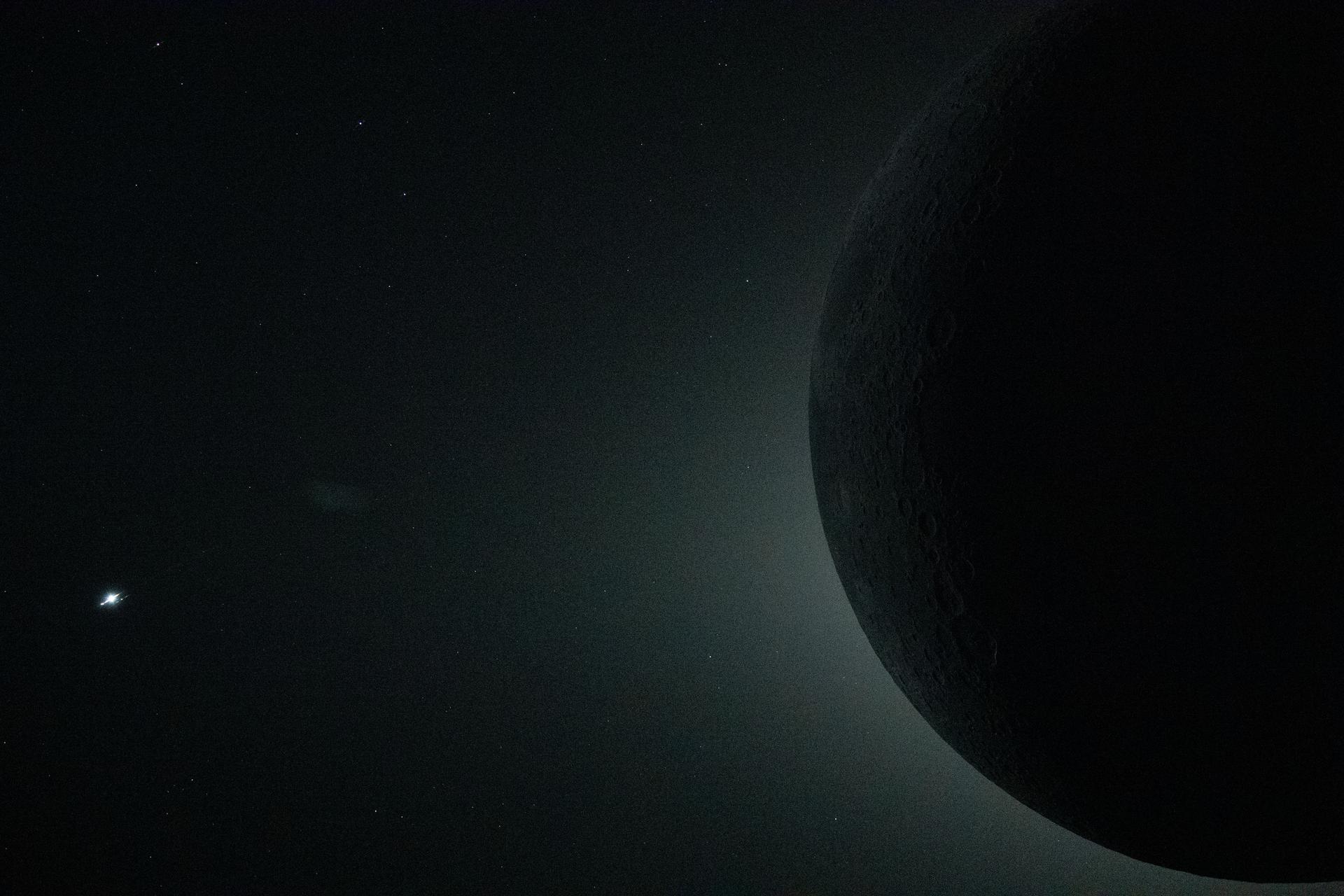
art002e009298 (April 6, 2026) – A close-up view from the Orion spacecraft during the Artemis II crew’s lunar flyby on...
art002e009298 (April 6, 2026) – A close-up view from the Orion spacecraft during the Artemis II crew’s lunar flyby on April 6, 2026, captures a total solar eclipse, with only part of the Moon visible in the frame as it fully obscures the Sun. Although the full lunar disk extends beyond the image, the Sun’s faint corona remains visible as a soft halo of light around the Moon’s edge. From this deep-space vantage point, the Moon appeared large enough to sustain nearly 54 minutes of totality, far longer than total solar eclipses typically seen from Earth. This cropped perspective emphasizes the scale of the alignment and reveals subtle structure in the corona during the rare, extended eclipse observed by the crew. The bright silver glint on the left edge of the image is the planet Venus. The round, dark gray feature visible along the Moon’s horizon between the 9 and 10 o’clock positions is Mare Crisium, a feature visible from Earth. We see faint lunar features because light reflected off of Earth provides a source of illumination.
More Images From This Period
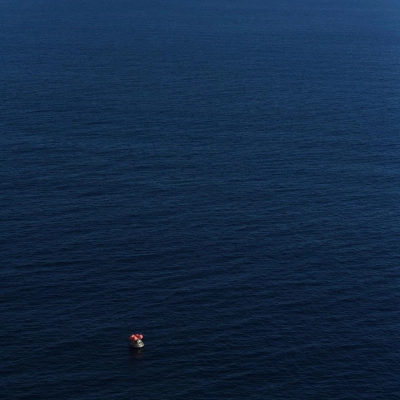
USS John P. Murtha approaches NASA's Orion spacecraft carrying Artemis II Commander Reid Wiseman, Pilot Victor Glover, and Mission Specialist...

NASA astronaut Victor Glover, Artemis II pilot is assisted off the flight deck after arriving aboard USS John P. Murtha...