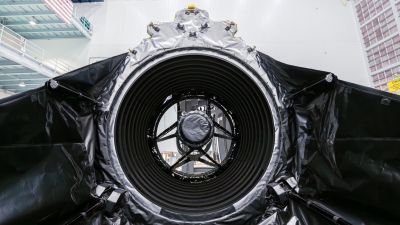
NASA's next flagship space telescope is named after Nancy Grace Roman, the agency's first Chief of Astronomy and the figure often called the "Mother of Hubble." Roman is built around the same 2.4-meter primary mirror as Hubble itself - but with a field of view roughly 100 times larger. That single architectural choice reframes what a space telescope can do. Roman is designed to survey wide swaths of sky, not to stare deeply at one target. The mission's three flagship surveys are aimed at dark energy, exoplanet microlensing, and the structure of the cosmic web.
Why Roman exists
The mission was originally proposed as WFIRST (the Wide-Field Infrared Survey Telescope) and was the top priority of the National Academies' 2010 decadal survey of astronomy. Its science case rests on three pillars: a high-latitude wide-area survey for dark-energy cosmology via weak gravitational lensing, a galactic-bulge microlensing survey for exoplanets, and a supernova survey to constrain the expansion history of the universe. Together these surveys produce the kind of statistical samples that single-target observatories like JWST cannot deliver.
Roman was renamed in 2020 to honor Nancy Grace Roman, who as NASA's first Chief Astronomer in the 1960s laid the groundwork for what became the Hubble Space Telescope.
How Roman differs from Hubble and JWST
Roman shares Hubble's 2.4-meter aperture - the mirror itself was originally built for a National Reconnaissance Office program and donated to NASA in 2012, a windfall that significantly reduced cost and schedule risk. But the optics behind the mirror are entirely different. Roman's Wide Field Instrument has a focal-plane array of 18 detectors arranged in a 3-by-6 mosaic, giving it a 0.28-square-degree field of view per pointing. Hubble's WFC3, by comparison, sees about 1/100th as much sky in a single image.
The wavelength coverage runs from about 0.5 to 2.3 microns - visible through near-infrared. JWST works almost entirely in the infrared (0.6 to 28 microns). The two telescopes complement each other: Roman is wide and fast, JWST is deep and detailed. Like JWST, Roman will operate at the Sun-Earth Lagrange point L2.
Two instruments: the Wide Field Instrument and the Coronagraph
The Wide Field Instrument (WFI) is the science engine. It operates in seven near-infrared filters and a low-resolution slitless spectrograph, designed for the survey workhorse modes. The 0.28-square-degree field of view is what enables Roman's surveys to cover thousands of square degrees of sky in reasonable observing time.
The Coronagraph Instrument (CGI) is a technology demonstrator. Coronagraphs block out a star's direct light so its planets become visible - a technique already mature on ground-based telescopes but never operated to this contrast level in space. CGI's goal is to demonstrate the high-contrast imaging needed for future missions like the Habitable Worlds Observatory, which aims to image Earth-like exoplanets directly. According to NASA's Roman site, CGI is expected to image known gas giants in reflected light - a stepping stone, not yet an Earth-analog detection.
Mission profile and launch
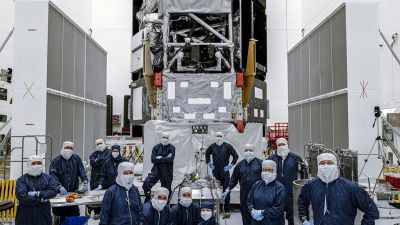
Roman's primary mission is five years of observation at L2. The launch vehicle is SpaceX's Falcon Heavy, selected in July 2022. NASA's current schedule targets a launch no later than May 2027, with internal effort aimed at an earlier launch-readiness date. As of 2026, integration and testing are in their late phases at NASA's Goddard Space Flight Center. You can follow Roman's mission milestones and launch readiness updates on our live Roman tracker.
Total lifecycle cost is approximately $4 billion. That's comparable to JWST's mid-development cost estimate but well below JWST's final cost - in part because Roman inherited the donated mirror and benefited from clearer scope discipline through the project's lifecycle.
What to expect in early science
Roman's observing time is divided into three core community surveys, designed in advance through the Roman Definition Committee process. The High-Latitude Wide-Area Survey will cover roughly 2,000 square degrees in five filters, providing the lensed-galaxy statistics needed for dark-energy constraints. The Galactic Bulge Time Domain Survey will monitor the dense star fields toward the Milky Way's center for microlensing events, expected to detect on the order of thousands of bound exoplanets - including planets at orbital distances JWST and current ground-based surveys cannot easily probe.
The Supernova Survey will repeatedly image patches of high-latitude sky to detect Type Ia supernovae out to high redshift, calibrating the cosmic distance ladder. Beyond these three core surveys, a portion of Roman's time is reserved for general-observer programs proposed through the Space Telescope Science Institute, which operates Roman's science operations center.
Roman's place in the post-JWST era
Roman is not a JWST replacement - it's a JWST complement. JWST stares; Roman surveys. A typical Roman pointing sees as much sky as 100 JWST pointings, but with shorter integration times. The two missions will collaborate on follow-up: Roman finds the candidates, JWST characterizes the most interesting ones in detail.
Roman also effectively succeeds Hubble's role as the wide-field workhorse. Hubble's WFC3, which has carried that load since 2009, will eventually be retired as Hubble's orbit decays. Roman picks up the wide-field visible-and-near-IR mission - on a much larger scale - and lays the engineering groundwork for the Habitable Worlds Observatory, NASA's next-generation flagship targeted for the 2040s. Whatever Roman finds in its first year will help shape the prioritization of that future mission.