Introduction to Dracula's Chivito
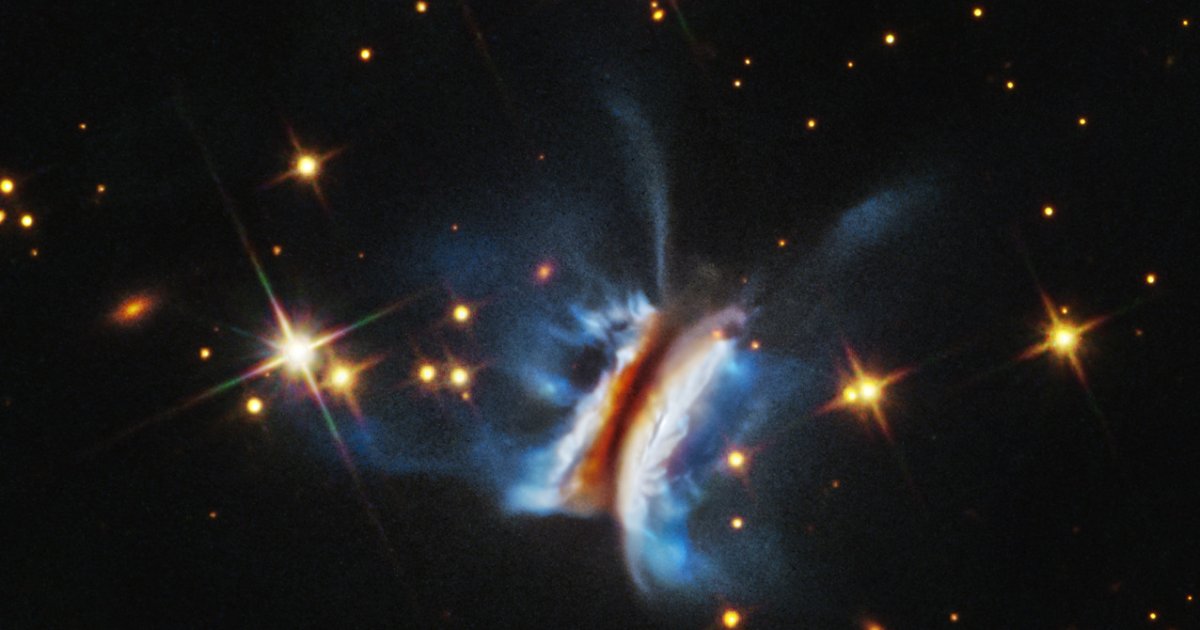
In a groundbreaking discovery, the Hubble Space Telescope has imaged the largest chaotic protoplanetary disk ever observed, known as Dracula's Chivito (IRAS 23077+6707). Located approximately 1,000 light-years away from Earth, this immense disk spans about 400 billion miles, offering a unique glimpse into the early stages of planet formation under extreme conditions. This discovery not only challenges existing theories but also provides a new perspective on how giant planets may form in turbulent environments.
The Chaotic Nature of Dracula's Chivito
Dracula's Chivito is characterized by its unexpected turbulence and the presence of asymmetric filaments that are prominently visible on only one side of the disk. According to ScienceDaily, these features suggest a highly dynamic environment, where gravitational forces and magnetic fields interact in complex ways. The chaotic nature of this disk is unlike any other observed before, raising questions about the stability and evolution of such systems.
Understanding the Asymmetric Filaments
The asymmetric filaments observed in Dracula's Chivito are particularly intriguing. Scientists estimate that these structures could be the result of interactions with nearby stellar objects or remnants of previous star-forming activities. The presence of these filaments on only one side of the disk suggests an uneven distribution of material, which may influence the formation of planets and other celestial bodies within the disk.
Implications for Giant Planet Formation
The discovery of Dracula's Chivito provides valuable insights into the process of giant planet formation in extreme environments. Traditionally, planet formation models have assumed relatively stable and symmetrical disks. However, the chaotic conditions observed in Dracula's Chivito indicate that planets can form in much more turbulent settings than previously thought.
These findings suggest that giant planets might form more rapidly in such environments, as the chaotic dynamics could lead to faster accretion of material. Additionally, the presence of asymmetric filaments might result in the formation of planets with unique orbital characteristics, potentially leading to highly eccentric or inclined orbits.
Future Research and Observations
The discovery of Dracula's Chivito opens new avenues for research into protoplanetary disks and planet formation. Future observations using both the Hubble Space Telescope and upcoming missions like the James Webb Space Telescope will be crucial in further exploring these chaotic environments. By studying Dracula's Chivito in greater detail, scientists hope to refine existing models of planet formation and gain a deeper understanding of the processes that govern the birth of planetary systems.
As researchers continue to analyze the data from Hubble's observations, the findings from Dracula's Chivito are expected to have far-reaching implications for our understanding of the universe. This discovery not only highlights the capabilities of the Hubble Space Telescope but also underscores the importance of continued exploration and study of the cosmos.