Discovery of oMEGACat BH-2: A Groundbreaking Revelation
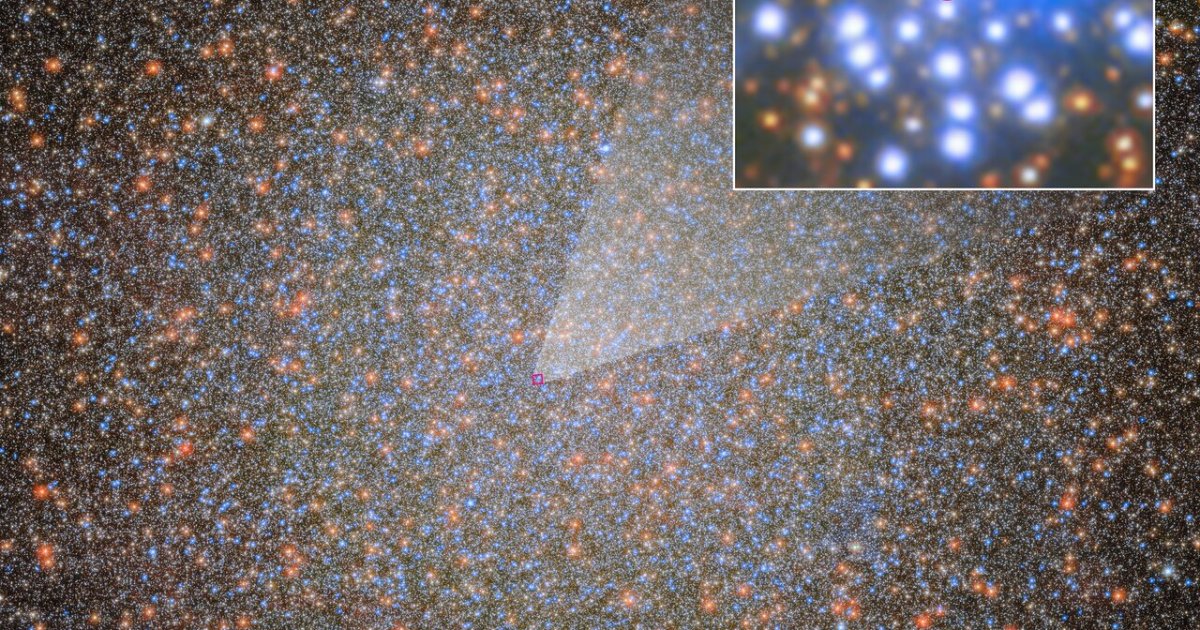
On July 13, 2026, NASA announced a landmark discovery: the first stellar-mass black hole detected in the globular cluster Omega Centauri, named oMEGACat BH-2. This black hole, with a mass of approximately 4.46 times that of our Sun, is paired with a main-sequence star of about 0.78 solar masses, and they orbit each other every 94 years. Located roughly 18,000 light-years away, this discovery was made possible through over two decades of precise astrometric measurements by the Hubble Space Telescope, complemented by near-infrared observations from the James Webb Space Telescope (JWST).
The Astrometric Method: Unveiling Hidden Giants
Astrometry, the precise measurement of stellar positions and movements, played a crucial role in identifying oMEGACat BH-2. Hubble's long-term monitoring allowed scientists to detect the subtle gravitational influence of the black hole on its companion star. The star's orbit exhibited perturbations that could only be explained by the presence of a massive, unseen companion—indicative of a black hole.
Further observations using the JWST's near-infrared capabilities helped rule out the possibility of a neutron star, as the spectral data did not match that of any known neutron star signatures. This combination of Hubble's astrometric precision and JWST's spectral analysis provided the conclusive evidence needed to confirm the existence of oMEGACat BH-2.
Implications for Black Hole Populations in Globular Clusters
The discovery of oMEGACat BH-2 has significant implications for our understanding of black hole populations within globular clusters. Traditionally, it was believed that stellar-mass black holes would be ejected from such dense environments due to gravitational interactions. However, the presence of oMEGACat BH-2 suggests that black holes can indeed exist and remain within these clusters.
This finding prompts scientists to reconsider models of globular cluster evolution and dynamics. It raises questions about the potential number of black holes that might be lurking within other globular clusters, undetected until now. Scientists estimate that there could be many more such black holes, challenging previous assumptions about their scarcity in these environments.
Future Prospects and Research Directions
The discovery of oMEGACat BH-2 opens new avenues for research into the life cycles of globular clusters and the role black holes play within them. Future studies may focus on identifying similar systems in other clusters, utilizing both Hubble and JWST's capabilities to refine our understanding of these cosmic phenomena.
Additionally, this discovery highlights the importance of long-term observational campaigns and the synergy between different space telescopes. As technology advances, we can expect more groundbreaking discoveries that will continue to reshape our understanding of the universe.
For more information, visit the European Space Agency's Hubble site and NASA's official website.