Introduction to Saturn's Rotation Mystery
For decades, scientists have been puzzled by Saturn's seemingly inconsistent rotation period. Unlike Earth, Saturn lacks a solid surface with fixed landmarks, making its rotation difficult to measure. The gas giant's rotation is typically gauged by observing its magnetic field, but these measurements have varied over the years, leading to a 40-year-long mystery. However, recent observations by the James Webb Space Telescope (JWST) have finally shed light on this enigma.
JWST's NIRSpec Observations
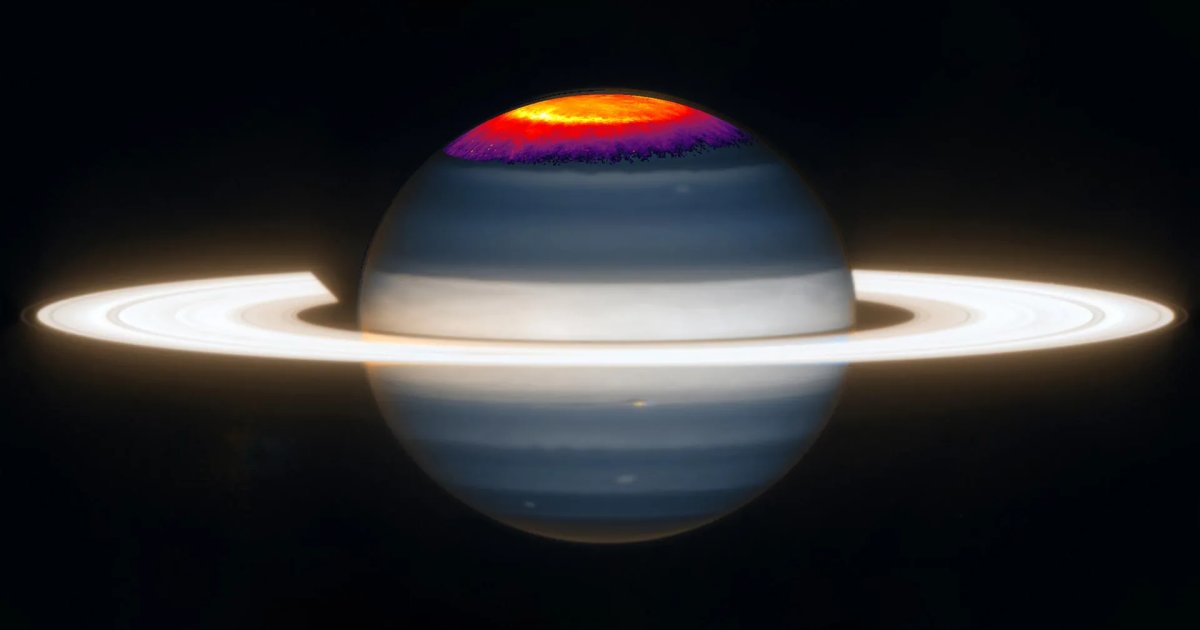
The breakthrough came from JWST's Near Infrared Spectrograph (NIRSpec), which focused on Saturn's northern aurora for an entire Saturnian day, which is about 10.7 Earth hours. By mapping the infrared emission of H3+ ions, researchers, led by Tom Stallard and his team, discovered a self-sustaining heat pump mechanism within Saturn's upper atmosphere. This finding was published in the Journal of Geophysical Research: Space Physics.
The Self-Sustaining Heat Pump
The process begins with the aurora heating the upper layers of Saturn's atmosphere. This heat generates powerful winds that circulate around the planet. These winds, in turn, create electrical currents that feed back into the auroral region, sustaining the cycle. This self-sustaining heat pump not only helps explain the variations in Saturn's rotation period but also highlights the complex interactions between its atmosphere and magnetosphere.
Atmosphere-Magnetosphere Coupling
The coupling between Saturn's atmosphere and its magnetosphere is crucial for understanding the planet's rotation dynamics. The electrical currents generated by the winds influence Saturn's magnetic field, which is used to measure its rotation. This newly discovered heat pump mechanism suggests that changes in the auroral activity can lead to variations in the magnetic field, thus affecting the perceived rotation period.
According to Northumbria University, this discovery not only solves the longstanding mystery but also provides insights into the atmospheric dynamics of other gas giants in our solar system and beyond.
Implications for Planetary Science
This finding has significant implications for the study of planetary atmospheres and magnetospheres. By understanding the self-sustaining processes in Saturn's atmosphere, scientists can better predict the behavior of other planetary systems. The research also underscores the importance of the JWST in advancing our knowledge of the solar system's outer planets.
While the study focused on Saturn, the principles of atmosphere-magnetosphere interactions could be applicable to other gas giants, such as Jupiter, and even exoplanets with similar characteristics. Scientists estimate that these findings could pave the way for new models of planetary dynamics, enhancing our understanding of the universe.
Conclusion
The James Webb Space Telescope's NIRSpec observations have provided a groundbreaking solution to Saturn's rotation mystery by uncovering a self-sustaining heat pump in its atmosphere. This discovery not only resolves a decades-old puzzle but also opens new avenues for research into the complex interactions between planetary atmospheres and magnetospheres. As we continue to explore the cosmos, the JWST remains a vital tool in unraveling the mysteries of our solar system and beyond.