Hubble's Latest Glimpse of the Trifid Nebula
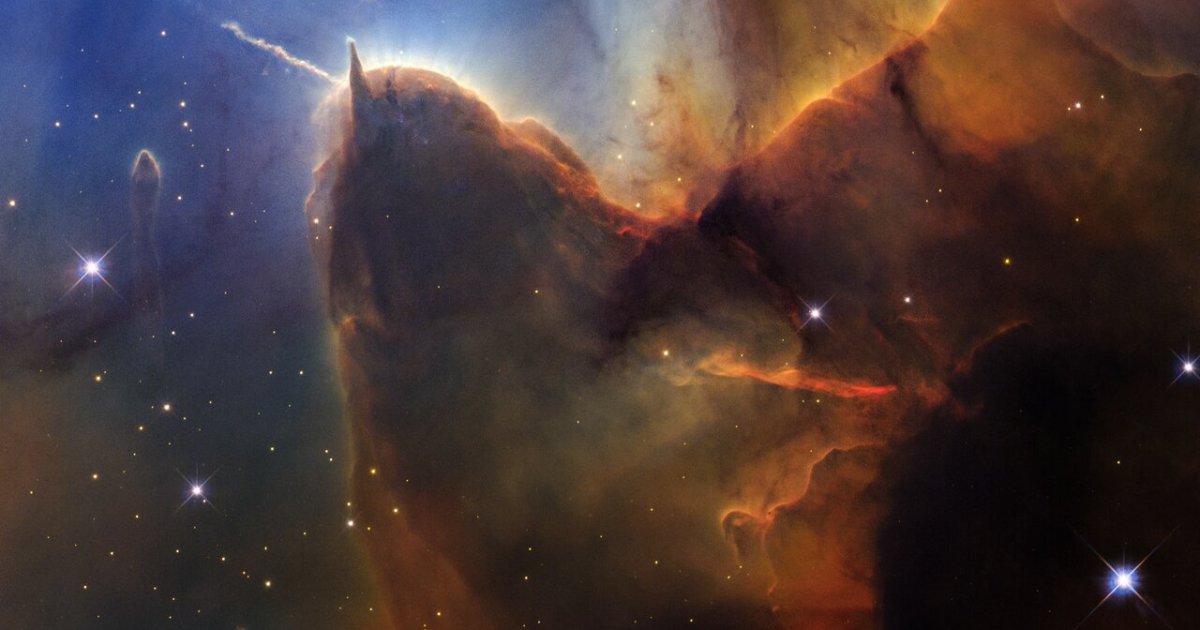
In celebration of its 36th anniversary, the Hubble Space Telescope has revisited the Trifid Nebula, a stellar nursery located approximately 5,000 light-years away in the constellation Sagittarius. This new image, captured by Hubble's Wide Field Camera 3, offers a stunning view of the Herbig-Haro 399 (HH 399) protostar jet, showcasing the dynamic processes of star formation.
Tracking the Evolution of Herbig-Haro 399
The Trifid Nebula is renowned for its vibrant colors and complex structure, which includes dark lanes of dust and glowing gas clouds. Among its most intriguing features is the HH 399 protostar jet, a stream of ionized gas ejected from a young star. This jet is a key indicator of ongoing star formation, providing insights into the mechanisms that drive stellar birth.
Hubble's recent image allows astronomers to compare the current state of HH 399 with observations made in 1997. The earlier image, taken with Hubble's Wide Field and Planetary Camera 2, first revealed the presence of this jet. By analyzing changes in its position and brightness over nearly three decades, scientists can track its motion and gain a deeper understanding of protostar evolution.
According to ESA/Hubble, the jet's movement suggests that the young star at its core is actively accreting material from its surrounding disk, a process that generates powerful outflows. These observations are crucial for refining models of star formation and understanding the life cycles of stars.
The Role of Massive O-Stars in Star Formation
The Trifid Nebula is not only a site of individual star formation but also a region where massive O-type stars exert significant influence. These stars, characterized by their high temperatures and intense ultraviolet (UV) radiation, play a pivotal role in shaping the nebula's environment.
Scientists estimate that the UV radiation from nearby O-stars can trigger star formation by compressing the surrounding gas and dust, leading to the collapse of molecular clouds. This process, known as UV-driven star formation, is evident in the Trifid Nebula, where new stars are born in the shadow of their massive predecessors.
Hubble's observations provide a window into these interactions, highlighting the complex interplay between different types of stars and the nebula's evolving structure. By studying these processes, astronomers can better understand how star formation is influenced by external factors, such as radiation and stellar winds.
Comparing 1997 and 2026 Observations
The comparison between Hubble's 1997 and 2026 images of the Trifid Nebula underscores the telescope's unique ability to monitor celestial phenomena over extended periods. The changes observed in HH 399 and the surrounding nebula offer valuable data on the timescales of star formation and the evolution of protostellar jets.
These long-term observations are critical for building a comprehensive picture of how stars form and evolve. As Hubble continues to operate alongside newer telescopes like the James Webb Space Telescope, its legacy of detailed, high-resolution imaging remains indispensable to the field of astrophysics.
Conclusion
Hubble's 36th anniversary image of the Trifid Nebula is a testament to the telescope's enduring contribution to our understanding of the universe. By capturing the dynamic processes within this stellar nursery, Hubble helps astronomers unravel the mysteries of star formation and the forces that shape our cosmos.
For more detailed information on the Trifid Nebula and Hubble's observations, visit the ESA/Hubble website.