JWST's Groundbreaking Discovery
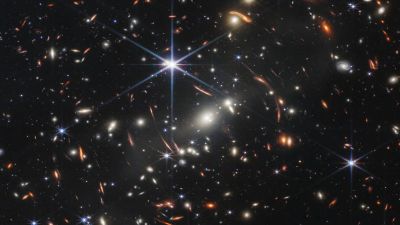
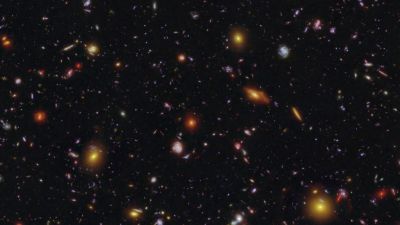
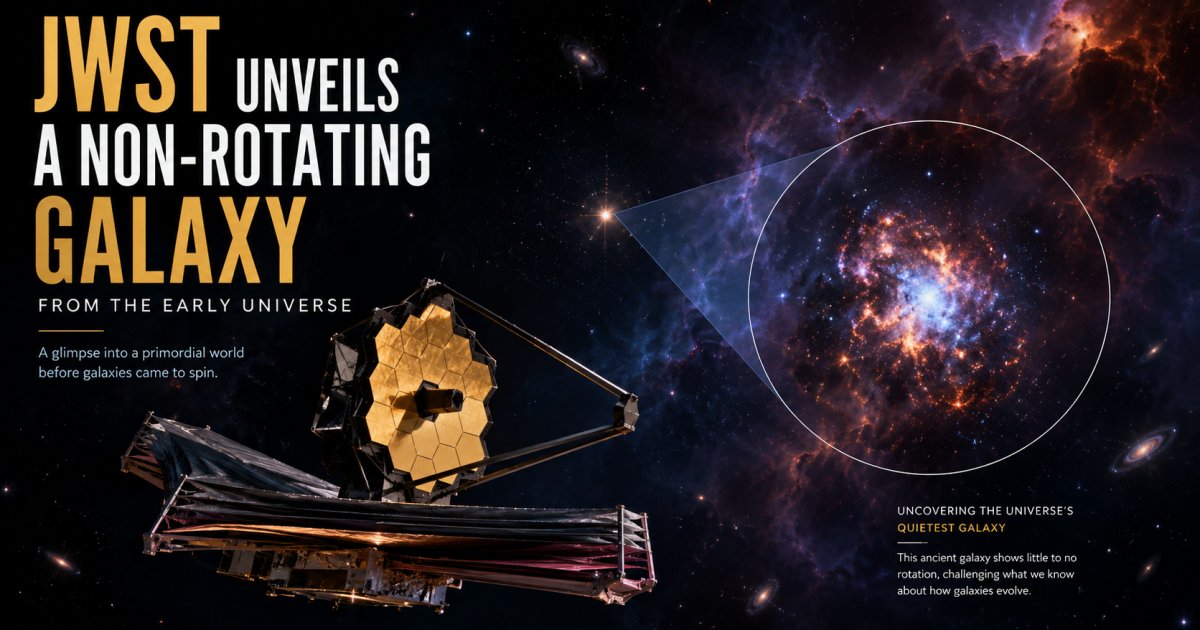
The James Webb Space Telescope (JWST) has once again pushed the boundaries of our understanding of the universe by discovering a giant galaxy that formed less than 2 billion years after the Big Bang. This galaxy, however, presents a peculiar trait: it shows no signs of rotation, a characteristic usually associated with much older, evolved galaxies. This unexpected finding challenges existing models of galaxy formation and evolution.
What NIRSpec and NIRCam Measured
The discovery was made possible by JWST's Near-Infrared Spectrograph (NIRSpec) and Near-Infrared Camera (NIRCam). These instruments are capable of capturing the faint light from distant galaxies, allowing scientists to analyze their properties in unprecedented detail. NIRSpec was used to measure the galaxy's spectrum, revealing its chemical composition and the velocities of its stars. NIRCam provided high-resolution images that helped determine the galaxy's structure.
Through these observations, scientists noted the absence of rotational motion in the galaxy's stars, a surprising finding given the galaxy's young age. Typically, galaxies in the early universe are expected to exhibit some degree of rotation as they form and evolve from smaller structures.
Why a Non-Rotating Young Galaxy is Unusual
Galaxies are generally thought to form from the gravitational collapse of gas and dark matter, gradually acquiring angular momentum that results in rotation. This process is believed to start early in a galaxy's life. Therefore, finding a young galaxy without rotation is unusual and suggests that its formation history might differ significantly from the standard model.
Non-rotating galaxies, often referred to as 'dispersion-dominated' systems, are typically seen in the local universe and are considered to be the result of mergers or other dynamic interactions that disrupt their rotation. The presence of such a galaxy in the early universe raises questions about the processes that might lead to its formation.
Implications for Galaxy Formation Models
This discovery has significant implications for our understanding of galaxy formation. It suggests that there might be alternative pathways for galaxy evolution that do not involve the gradual acquisition of angular momentum. Scientists estimate that interactions such as mergers or the influence of dark matter might play a more substantial role in shaping galaxies than previously thought.
The finding also indicates that the early universe might have been more dynamic and chaotic than current models suggest, with various processes influencing galaxy formation and evolution in ways not yet fully understood.
Future Studies and Observations
In light of this discovery, scientists are eager to conduct further studies to understand the mechanisms behind the formation of non-rotating galaxies. Future observations with JWST will focus on identifying more such galaxies and examining their environments to determine the factors contributing to their unique characteristics.
Researchers also plan to use computer simulations to explore scenarios that could lead to the formation of non-rotating galaxies in the early universe. These studies will help refine existing models and potentially develop new theories about galaxy evolution.
As JWST continues to observe the cosmos, it is expected to uncover more surprises that will further our understanding of the universe's history and the complex processes that govern galaxy formation.
For more information on JWST's latest discoveries, visit NASA's official website and ESA's Webb page.