Unveiling the Cosmic Beauty of MACS0329-0211
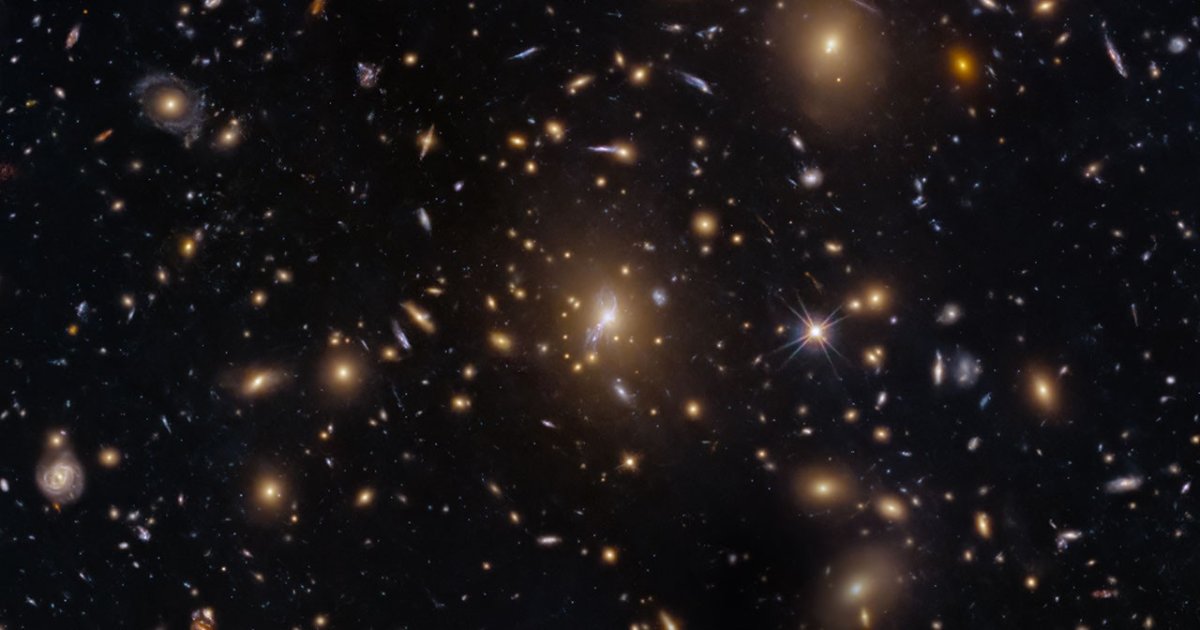
On June 12, 2026, NASA's Hubble Space Telescope captured a mesmerizing image of the galaxy cluster MACS0329-0211, located billions of light-years away from Earth. This image, taken using Hubble's Advanced Camera for Surveys (ACS) and Wide Field Camera 3 (WFC3), reveals a fascinating array of cosmic phenomena, including a distorted figure-eight gravitational lens and a diverse mix of galaxies.
The Enigmatic Figure-Eight Gravitational Lens
At the center of the cluster, a remarkable figure-eight shaped gravitational lens captures the attention of astronomers and enthusiasts alike. This phenomenon is likely a result of a background galaxy being multiply-imaged by the immense gravitational field of MACS0329-0211. The cluster's mass bends the light from the distant galaxy, creating the distinctive figure-eight pattern. Such gravitational lenses not only provide a visually stunning spectacle but also offer a unique opportunity to study the mass distribution within galaxy clusters, including the elusive dark matter.
Faint Lensed Arcs in the Upper-Right Quadrant
In addition to the prominent figure-eight lens, the Hubble image reveals faint lensed arcs in the upper-right quadrant of the cluster. These arcs are the stretched and distorted images of more distant galaxies, further testament to the gravitational prowess of MACS0329-0211. Scientists estimate that these lensed features can help map the dark matter distribution within the cluster, offering insights into the unseen scaffolding of the universe.
A Diverse Mix of Galaxies
The image of MACS0329-0211 showcases a rich tapestry of galaxies, each with its unique characteristics. Among them are elliptical galaxies, known for their smooth, featureless light profiles, and lenticular galaxies, which appear edge-on with a central bulge and a disk. Face-on spiral galaxies add to the diversity, displaying their iconic swirling arms. This mix of galaxy types provides a valuable snapshot of the evolutionary processes at play within galaxy clusters.
Hubble's ACS+WFC3 Program on X-ray Bright Galaxy Clusters
The observation of MACS0329-0211 is part of Hubble's ACS+WFC3 program, which focuses on X-ray bright galaxy clusters. These clusters are among the most massive structures in the universe, and their study is crucial for understanding the large-scale structure of the cosmos. The program aims to explore the interplay between visible and dark matter in these clusters, using gravitational lensing as a powerful tool to probe their mass distribution.
Hubble's observations, in conjunction with data from other telescopes like the Chandra X-ray Observatory, enable astronomers to build comprehensive models of galaxy clusters. These models help in unraveling the mysteries of dark matter and the role it plays in the formation and evolution of cosmic structures.
For more details on the Hubble image of MACS0329-0211, you can visit the Sci.News article that provides an in-depth analysis of this captivating cosmic event.