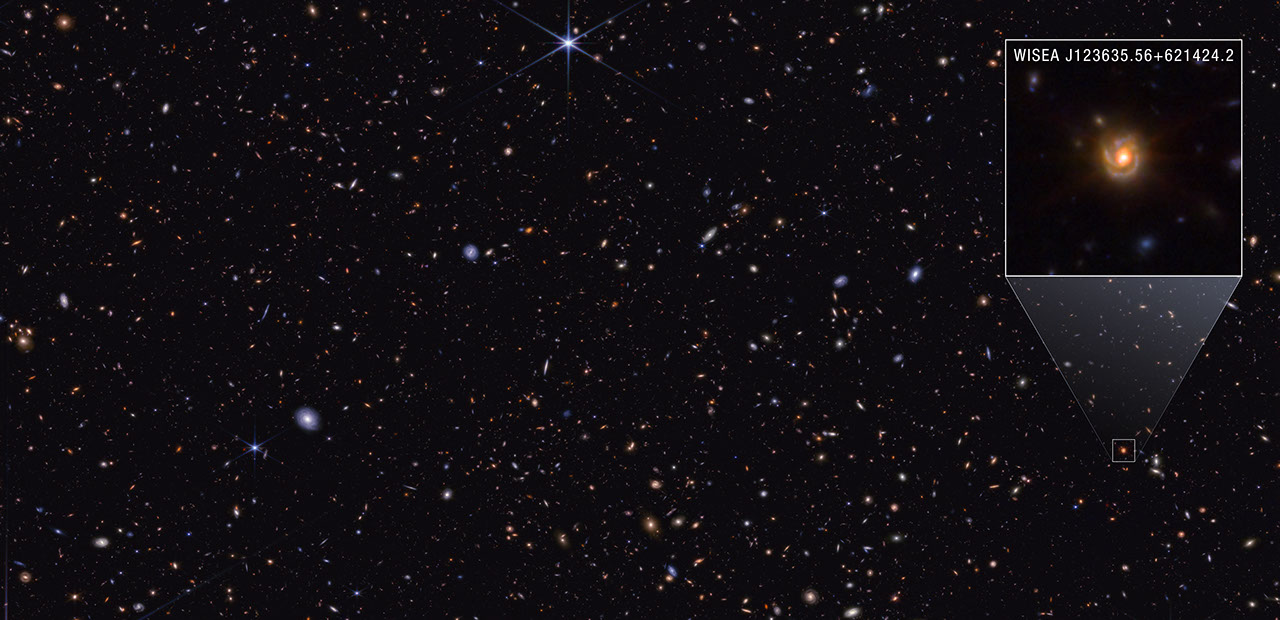
Saguaro in GOODS-North Field (NIRCam)
·
NASA/ESA/CSA/STScI
First discovered by NASA’s James Webb Space Telescope in 2022, little red dots (LRDs) have continued to perplex scientists. Although they appear abundant at high redshifts early in the universe, they rapidly decrease in number at lower redshifts.
To explore why LRDs decrease in number as the universe ages, researchers examined lower-redshift spiral galaxy WISEA J123635.56+621424.2. Nicknamed the “Saguaro” for its prominent arms, like the cactus native to the Sonoran Desert in the Southwestern United States, this redshift 2 galaxy contains an LRD-like center.
Image Details
About the Object
| R.A. Position | 12:36:35.56 |
|---|---|
| Dec. Position | +62:14:24.3 |
| Constellation | Ursa Major |
| Dimensions | This image is about 8 arcminutes across. |
About the Data
| Data Description | This image was created with Webb data from proposal: 1181 (D. Eisenstein) |
|---|---|
| Instrument | NIRCam |
| Exposure Dates | 04-05 February 2023 |
| Filters | F090W, F115W, F150W, F200W, F277W, F335M, F356W, F410M, F444W |