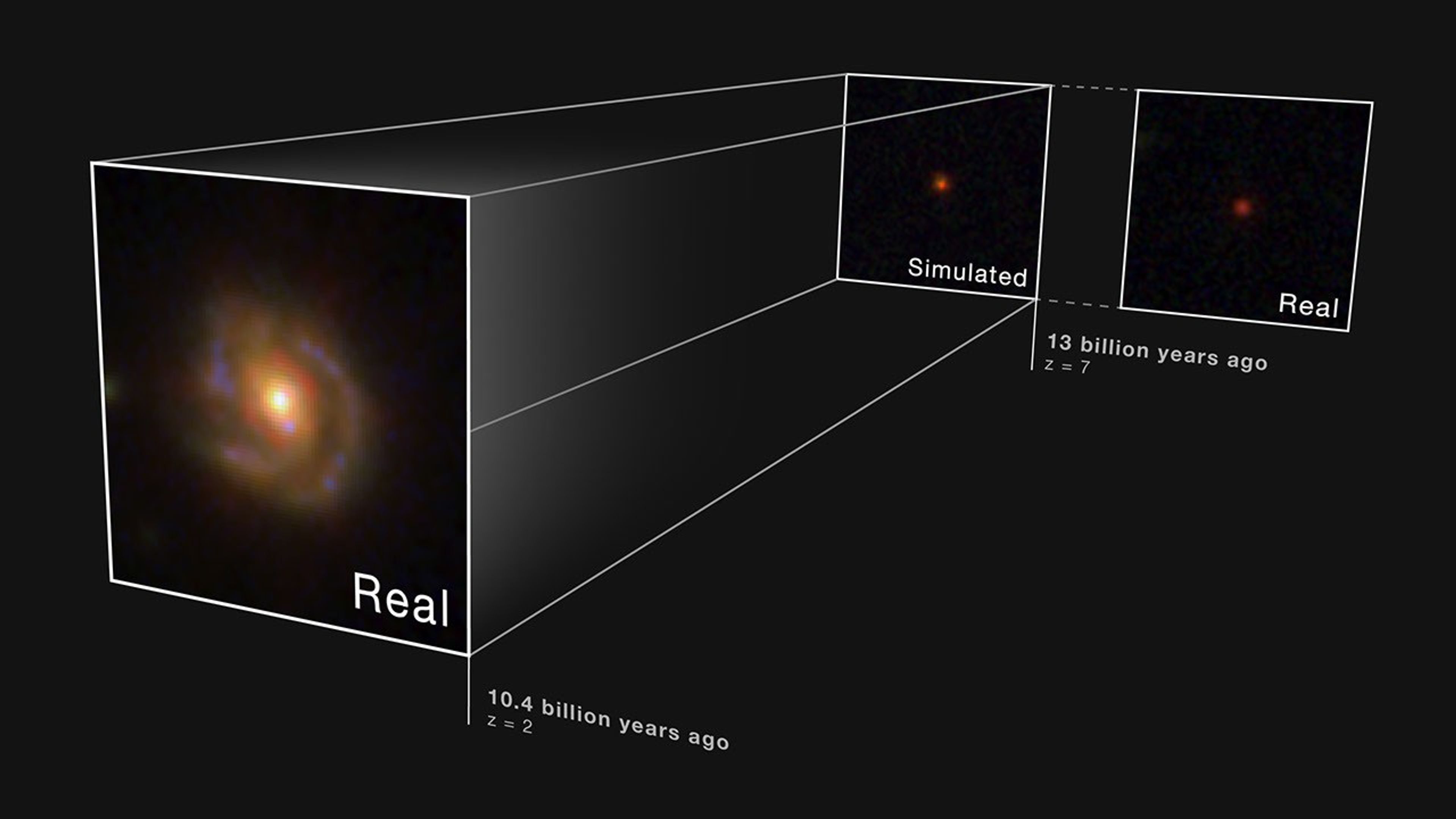
Little Red Dot at Redshift 2: Real and Simulated Graphic
Scientists analyzed Hubble’s ultraviolet- and Webb’s infrared-imaging and spectroscopic archival data, respectively, to confirm lower-redshift spiral galaxy WISEA J123635.56+621424.2 — nicknamed the “Saguaro” for its prominent spiral arms — met the criteria of a prototypical LRD. Additionally, the team synthetically shifted the galaxy to a higher redshift to find out how this galactic environment would appear to observers if located in the early universe.
As the team expected, the Saguaro’s surrounding galactic structure fades so that only the bright, LRD-like source at its center is visible. This suggests that although LRDs may seem like a unique galaxy population, they are actually affected by observational bias and some features just don’t appear at higher redshifts with current technology.