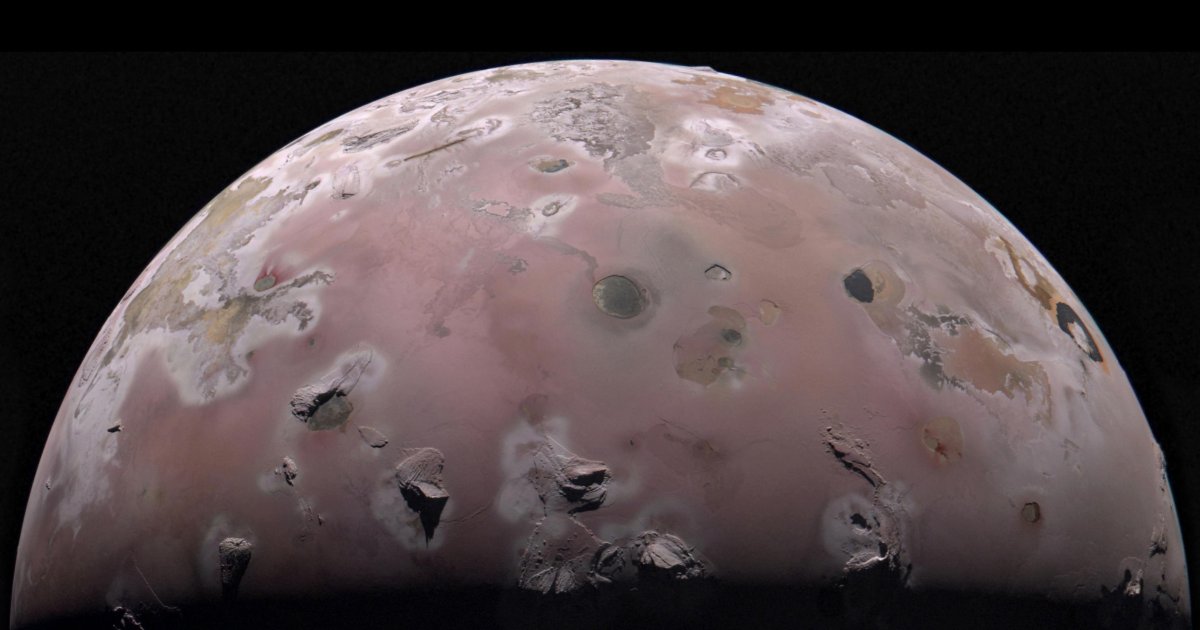
Juno's Microwave Radiometer: Peering Beneath Io's Surface
In a groundbreaking discovery, NASA's Juno mission has provided the first subsurface temperature profile of Io, Jupiter's most volcanic moon. During flybys on December 30, 2023, and February 3, 2024, Juno's Microwave Radiometer (MWR) revealed that temperatures beneath Io's crust rise more than 20 degrees Celsius within just a few meters. This finding offers unprecedented insights into the moon's internal heat dynamics and volcanic activity.
Understanding Io's Intense Heat Flow
Io is renowned for its intense volcanic activity, driven by the gravitational tug-of-war it experiences with Jupiter and other moons. This tidal heating generates significant internal heat, which scientists have long speculated about but have only now begun to quantify accurately. Juno's MWR data indicates that the heat flow beneath Io's surface ranges from 1 to 3 watts per square meter. This is up to 30 times greater than Earth's global average heat flow, suggesting a highly active subsurface environment.
Implications of the Subsurface Temperature Profile
The temperature increase detected by Juno's MWR, occurring within a few meters beneath Io's crust, aligns with theories of conductive tidal heating or cooling of lava flows beneath a crust estimated to be 9 to 11 meters thick. These findings are consistent with the presence of extensive subsurface volcanic activity, which could be responsible for the moon's dramatic surface features, including its numerous active volcanoes and lava lakes.
Understanding the heat flow and subsurface conditions of Io is crucial for planetary science. It provides insights into the moon's geologic activity and helps refine models of tidal heating, which could be applicable to other celestial bodies experiencing similar gravitational interactions.
Future Prospects for Juno and Io
The success of these flybys and the data gathered by Juno's MWR open new avenues for research into Io's geological and thermal characteristics. As Juno continues its mission, further flybys could provide even more detailed information about Io's subsurface conditions, enhancing our understanding of this enigmatic moon.
For more detailed information, you can visit NASA's official Juno mission page.