Introduction to the Discovery
On June 11, 2026, NASA's Chandra X-ray Observatory revealed a fascinating discovery in the Sagittarius C (Sgr C) star-forming region, located near the Milky Way's Galactic Center. This potential supernova remnant, approximately 26,000 light-years away, offers a new window into the dynamic processes occurring in this densely packed area of our galaxy.
The X-ray Blob: A Closer Look
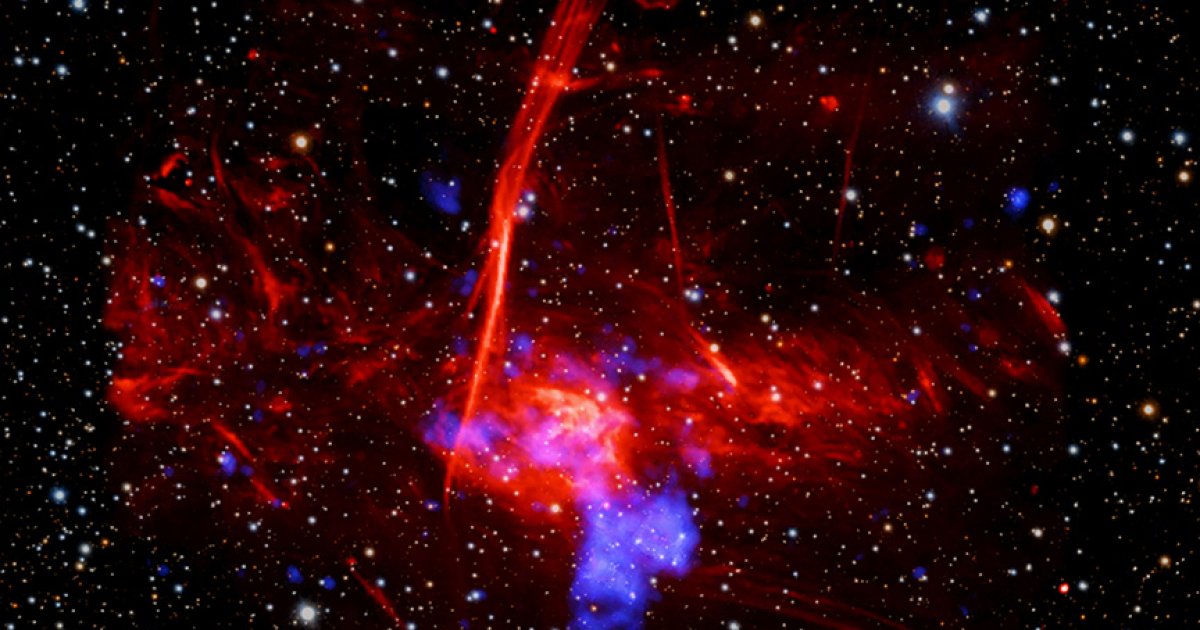
The discovery centers around an intriguing X-ray blob situated within an H II region, a cloud of ionized hydrogen gas, surrounding a young massive star. This blob is believed to be the remnants of a supernova explosion, expanding at a staggering speed of about 2 million miles per hour. Scientists estimate that this remnant is around 1,700 years old, providing a relatively recent snapshot of stellar death and rebirth.
Composite Imaging: A Multi-Wavelength Approach
The identification of this potential supernova remnant was made possible through a composite image that combines data from multiple observatories. Alongside Chandra's X-ray observations, contributions from the European Space Agency's XMM-Newton, the MeerKAT radio telescope, NASA's James Webb Space Telescope (JWST), and the Pan-STARRS optical survey have been instrumental. This multi-wavelength approach allows astronomers to piece together a more comprehensive picture of the phenomena occurring in Sgr C.
The composite image showcases the X-ray emissions from the supernova remnant, the radio waves captured by MeerKAT, the infrared observations from JWST, and the optical data from Pan-STARRS. Each wavelength reveals different aspects of the remnant's structure and composition, offering insights into its interaction with the surrounding interstellar medium.
Proximity to Sagittarius A*
One of the most compelling aspects of this discovery is the remnant's proximity to Sagittarius A* (Sgr A*), the supermassive black hole at the center of the Milky Way. Located within a few hundred light-years of Sgr A*, the Sgr C region is a bustling hub of stellar activity and gravitational interactions. The presence of a supernova remnant in such a dynamic environment raises intriguing questions about the interplay between massive stars, supernovae, and black holes.
Implications for Galactic Center Studies
The potential supernova remnant in Sgr C offers a unique opportunity to study the lifecycle of stars in one of the most extreme environments in our galaxy. By examining the remnants of this stellar explosion, scientists can gain valuable insights into the processes that govern star formation and death near a supermassive black hole.
Moreover, understanding the dynamics of supernova remnants in the Galactic Center can help astronomers refine models of galactic evolution and the role of supernovae in distributing heavy elements throughout the galaxy. These elements are crucial for the formation of planets and, ultimately, life itself.
Future Observations and Research
As researchers continue to analyze the data from Chandra and its partner observatories, further observations will be crucial to confirm the nature of this X-ray blob as a supernova remnant. Future studies may focus on the chemical composition of the remnant, its interaction with nearby stars and gas clouds, and its potential influence on the Galactic Center's complex gravitational landscape.
In addition, ongoing observations with telescopes like JWST and upcoming missions will provide even more detailed views of the Sgr C region, helping to unravel the mysteries of our galaxy's core.