Meet NASA’s New Artemis II Science Officers
Business attire, headsets, and multiple computer monitors are a much different backdrop than hiking gear, rock hammers, and the volcanic fields of Iceland. For Kelsey Young of NASA's Goddard Space Flight Center in Greenbelt, Maryland, and Trevor Graff and Angela Garcia of NASA's Johnson Space Center in Houston, comfort and skill across both environments have made them uniquely suited to be certified as NASA’s first Artemis II science officers.
The integration of science operations into human spaceflight dates back to Apollo, but Artemis introduces a new dedicated position in NASA's Mission Control, marking an evolution of how science is embedded in mission operations.
“The science officer is the senior flight controller responsible for lunar science and geology objectives during Artemis missions,” said Young, who also serves as NASA's Artemis II lunar science lead. “They will integrate with all the other console disciplines and ensure NASA’s lunar science objectives are seamlessly integrated into mission execution.”

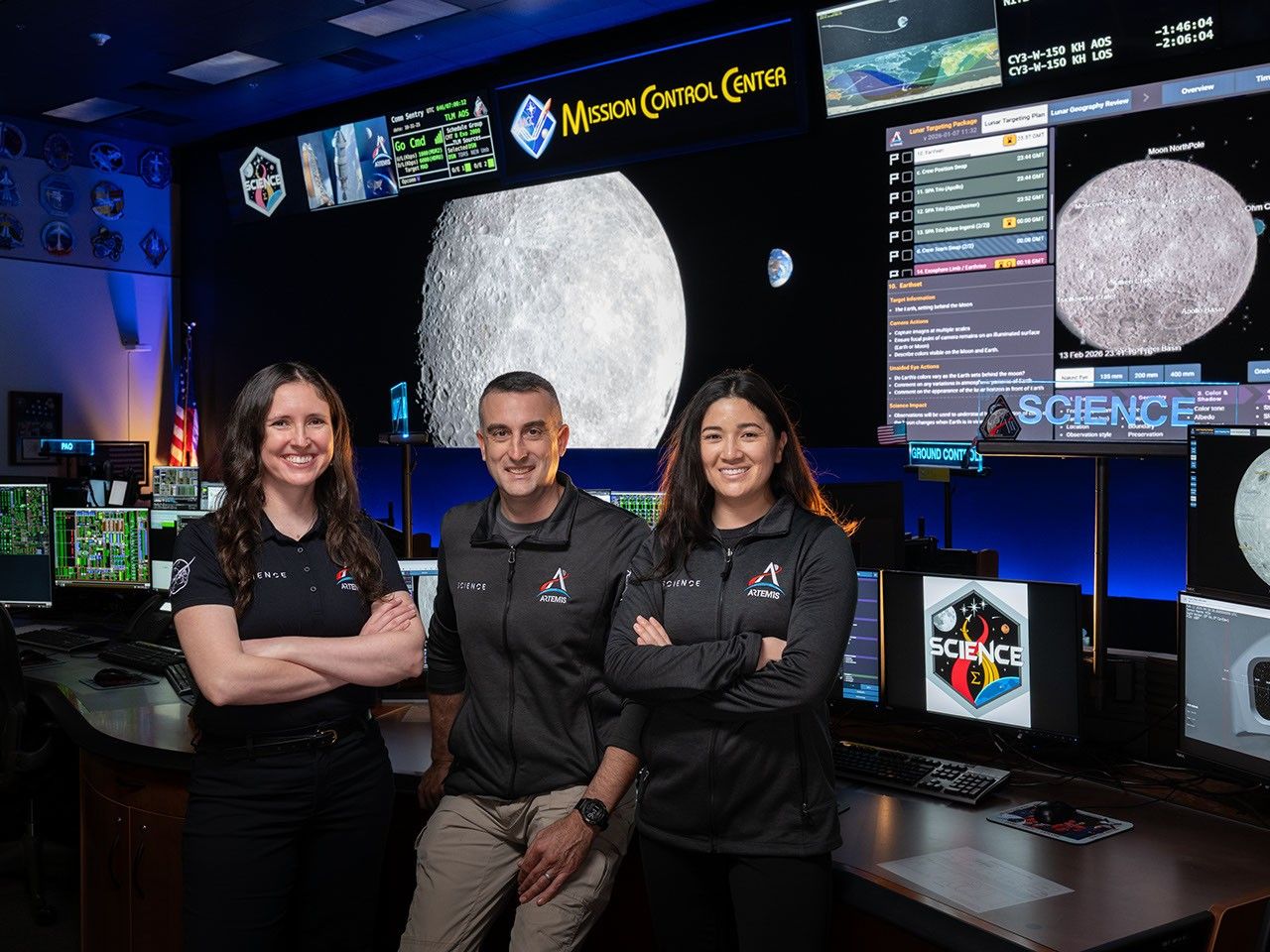
Artemis science officers, from left, Kelsey Young, Trevor Graff, and Angela Garcia stand at the new SCIENCE console in the Mission Control Center at NASA’s Johnson Space Center in Houston. Credits NASA/Josh Valcarcel
The front room of Mission Control is filled with consoles, or workstations, each dedicated to a particular system or function of the mission. Flight controllers at each console monitor areas such as communications, life support, propulsion, and now, science. Many of the console positions are supported by larger teams of experts who work from either different “back rooms” at NASA’s Johnson Space Center in Houston, or other locations.
Young, Garcia, and Graff completed months of flight controller training, testing, and certification simulations in Mission Control, while also executing geology and lunar observation trainings and integrated simulations with the astronauts.
One of the most exciting, challenging, and rewarding components of the process are the simulations, where we tested our skills and knowledge while immersed in very realistic mission scenarios.
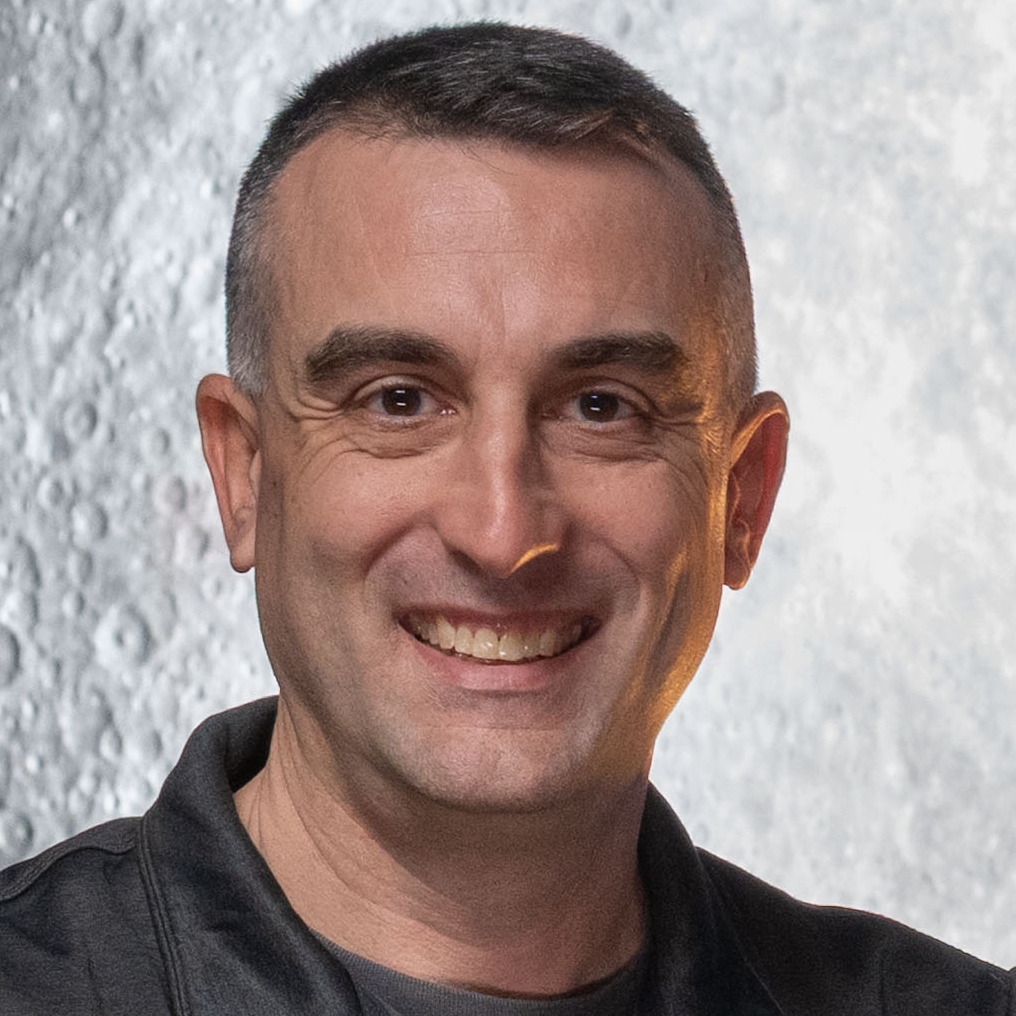
Trevor Graff
Artemis Science Officer
“One of the most exciting, challenging, and rewarding components of the process are the simulations, where we tested our skills and knowledge while immersed in very realistic mission scenarios,” said Graff.
The simulations often included the Artemis II astronauts and covered the lunar flyby portion of the mission, planned for Monday, April 6, during which time the crew will take photographs of the Moon and record audio of their observations. They will be the eyes of the lunar scientists on Earth and have gone through geology training in the classroom and in the field to be able to capture as much information as possible during their pass around the far side of the Moon. Young said the astronauts have worked incredibly hard at building their lunar science toolboxes, studying lunar geography, traipsing across lunar-like landscapes in Iceland, and cultivating their ability to provide scientifically impactful descriptions of the Moon.
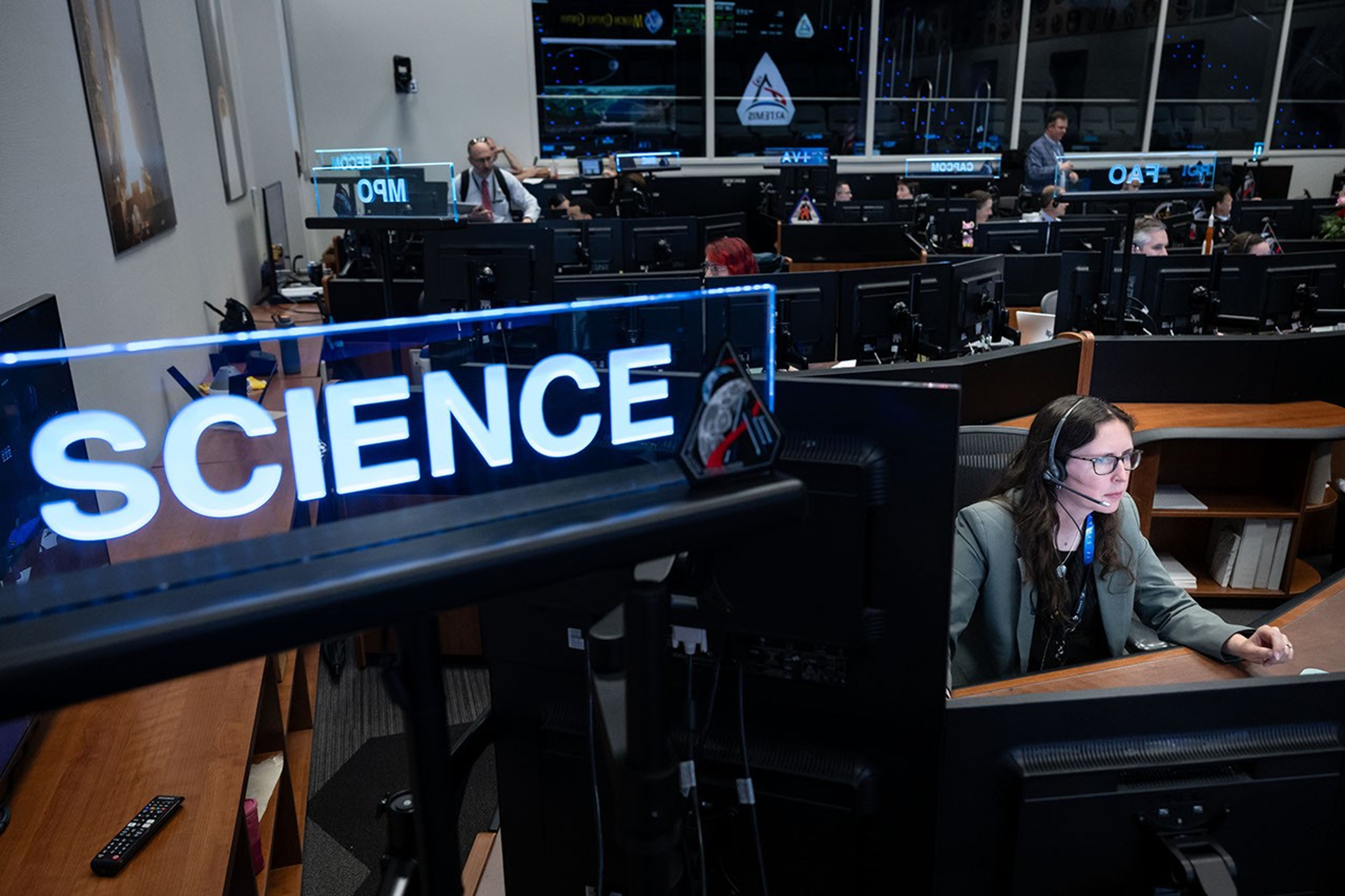
Artemis II science officer Kelsey Young monitors science operations at the new SCIENCE console in NASA's Mission Control Center. Credits: NASA/Bill Stafford
Listen to this audio clip from Kelsey Young talking about how the Artemis II astronauts have studied lunar geography to prepare for their mission. Credit: NASA's Curious Universe
As the astronauts make those observations, their photos and recorded audio will be fed down to two science back rooms at NASA Johnson, the Science Evaluation Room and Science Mission Operations Room. Experts in these rooms will provide data analysis and strategic guidance in real time to the science officer in Mission Control. These processes represent a major component of Artemis II as a test flight: refining science mission operations.
This mission will test the lunar science team’s workflows, technical requirements, and integration into Mission Control. Lessons learned during Artemis II will pave the way for lunar science operations for future Artemis missions. Young explained that science integration into human spaceflight has a long, rich history. While there was no science representative in the front room of Mission Control during Apollo, there was a geology back room onsite at Johnson. As Apollo missions progressed, the structure of integrating with the rest of the flight control team evolved and the footprint expanded as the science capability of each mission grew.
Garcia said she is humbled, honored, and grateful to be a part of the flight control team and to have trained the astronauts. The Moon is something everyone, everywhere, can see and connect with, according to Young.
“I hope people all over the world can be inspired by this push away from our planet,” said Young, “I also hope they remember the Moon, how much we still have to learn about our nearest neighbor but also the special place it holds to people everywhere.”