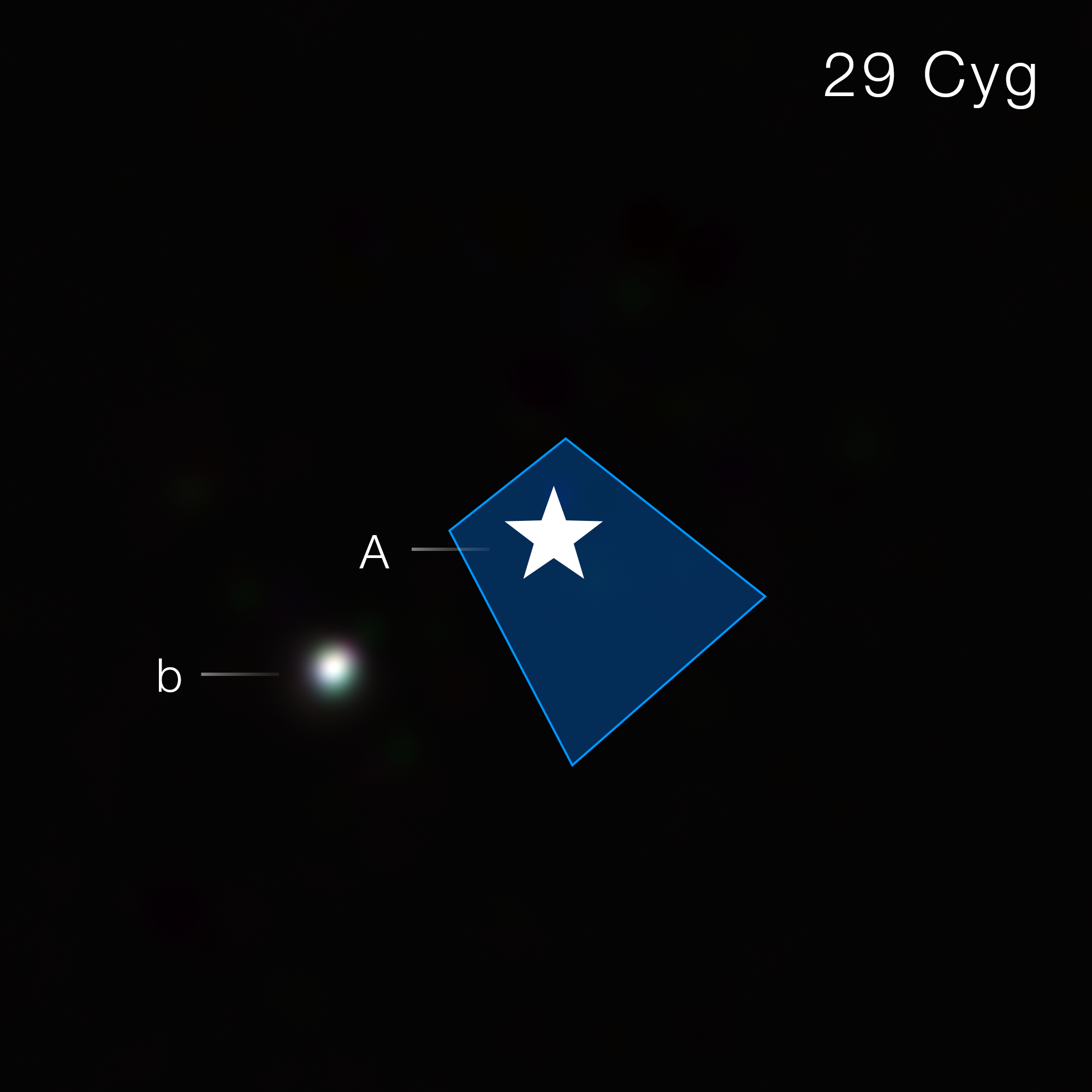
Exoplanet 29 Cygni b (NIRCam Image)
Astronomers used NASA’s James Webb Space Telescope to directly image 29 Cygni b, which weighs 15 times Jupiter. They found evidence for heavy chemical elements like carbon and oxygen, which strongly suggests it formed like a planet by accretion within a protoplanetary disk, and not like a star through fragmentation.
Webb’s NIRCam (Near-Infrared Camera) was used in its coronagraphic mode, in which a wedge (indicated by the blue box) is used to block the light of the host star (labeled A and marked with a star symbol) to reveal the planet. This image combines light from three filters between 4 and 5 microns. The planet is brightest in the blue filter, then green, then red, so it appears as an off-white dot in the color composite. If carbon dioxide weren’t present, the planet would appear noticeably redder.
In this image, the color blue is assigned to 4.1 micron light, green to 4.3 micron light, and red to 4.6 micron light.
Image Details
About the Object
| R.A. Position | 20:14:32.2 |
|---|---|
| Dec. Position | +36:48:24.5 |
| Constellation | Cygnus |
| Distance | About 133 light-years |
About the Data
| Data Description | The Webb observations include those from program: 6095 (W. Balmer). |
|---|---|
| Instrument | NIRCam> coronagraph mode |
| Exposure Dates | 01 Sept 2025 |
| Filters | F410M, F430M, F460M |